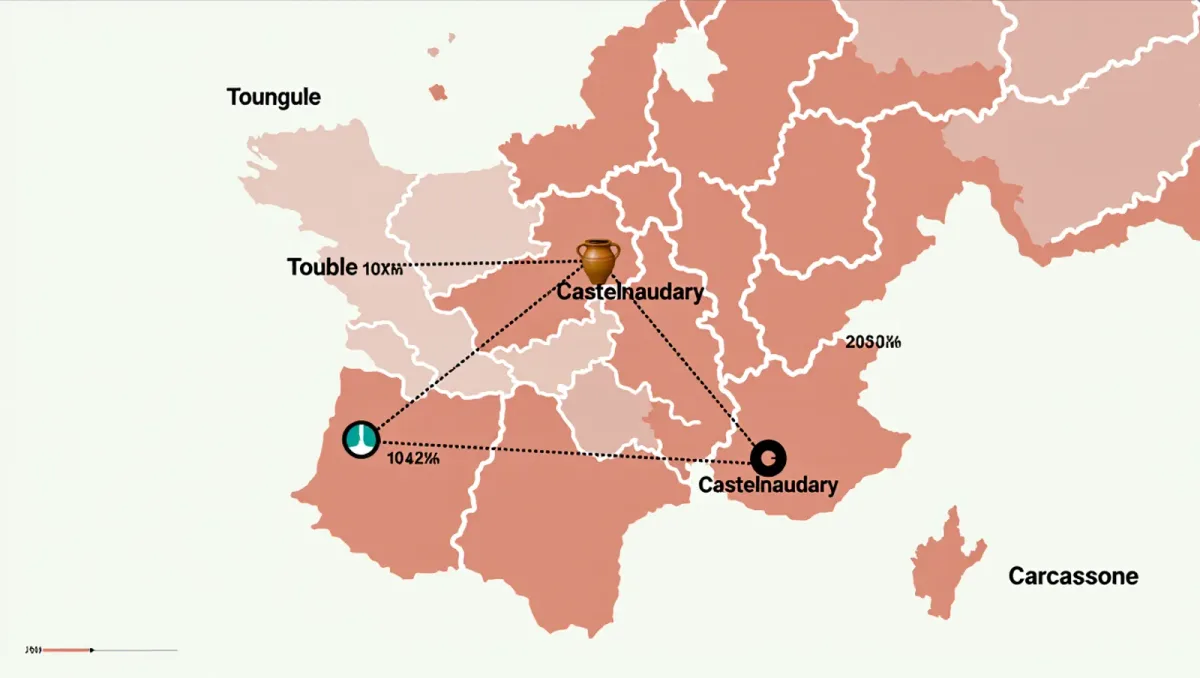
Cassoulet — the slow-baked clay pot of white beans, confit duck, and pork that anchors the cooking of France's southwest — belongs to no single kitchen, but its heartland is precisely mapped: the triangle between Castelnaudary, Carcassonne, and Toulouse in the Occitanie region, where January is both peak season for the dish and the quietest month to visit the towns that argue about it.
This guide follows that triangle town by town: who claims the cassoulet and on what grounds, what the dish is supposed to contain according to its self-appointed guardians, what to drink beside it, and how a few winter days in the Aude and Haute-Garonne can be built around the pot. Figures cited are indicative ranges from the brotherhoods' own published materials and regional tourism sources as of early 2026.
What is cassoulet, and why do three towns fight over it?
At its plainest, a cassoulet is dried white beans (traditionally the local lingots de l'Aude or Tarbais varieties) baked for hours with preserved meats in an earthenware dish called a cassole, fired in the potteries of Mas-Saintes-Puelles near Castelnaudary. The dispute is about what else goes in. Castelnaudary, which calls itself the world capital of the dish, holds for pork, duck confit, and a pork skin lining; Carcassonne adds partridge in some tellings and lamb in others; Toulouse insists on the Toulouse sausage and claims the recipe as its own.
Food historians generally treat the argument as local pride rather than archaeology — the bean itself arrived from the Americas in the 16th century, and the dish's written record only gathers from the 18th. Unlike Champagne or Roquefort, cassoulet carries no European protected status; its defense is performed by brotherhoods, most prominently the Grande Confrérie du Cassoulet de Castelnaudary, founded in 1973, which stages the town's Fête du Cassoulet each August and judges restaurant versions year-round.
Castelnaudary: the capital, for better and for worse
Castelnaudary is a modest canal town on the Canal du Midi — itself a UNESCO World Heritage listing since 1996 — about 45 minutes southeast of Toulouse by car. Its grand-dish tradition is visible at midday: most of the town's brasseries along the Grand Bassin serve a single-serving cassole of cassoulet castelnaudaryais at lunchtime only, with a simple green salad and a glass of Malepère or Cabardès red from vineyards just to the south and west. A full portion runs roughly €15 to €25 in 2026; portions are sized with the confidence of a town that stakes its identity on the dish.
The practical traveler's note: cassoulet here is a lunch dish in the strict sense. Kitchens make one batch a day, and by mid-afternoon the better tables have run out. Arrive at 12:30 sharp or book ahead.
Carcassonne: the dish and the fortress
Forty kilometers south, Carcassonne pairs the pot with one of the most visited monuments in France — the medieval Cité, restored in the 19th century by Viollet-le-Duc and inscribed by UNESCO in 1997. The old city's restaurants cater heavily to day-trippers, and quality is uneven; the reliable winter play is to eat in the lower town (the Bastide Saint-Louis) around Place Carnot, where several family kitchens serve their own take on the dish, sometimes with the partridge variant the town's claim rests on.
January, it should be said, is the cheapest and least crowded month to see the Cité — a fortress with restaurant tables inside its walls in high summer becomes a working monument again, and the cassoulet tastes accordingly local.
Toulouse: the sausage city stakes its claim
Toulouse makes the case loudly and well. The city's version puts the fat Toulouse sausage forward alongside duck confit, and the dish anchors the carte of the city's traditional bistrots — the rooms around Place Wilson and the Marché Victor Hugo, the covered market where most of them shop in the morning. Victor Hugo's first-floor tables and butchers' counters are a useful prelude: foie gras, duck legs curing in fat, and casiers of beans from the region's mills all on display before 11 a.m.
Toulouse also widens the table beyond the pot: the city sits at the northern edge of Armagnac country in the neighboring Gers, and most serious wine lists carry Bas-Armagnac by the glass — the brandy the southwest drinks with this exact meal. A two-night Toulouse stay lets you compare the city's cassoulet with the Castelnaudary original and settle the argument for yourself, which is the only honest way to end it.
What do you drink with cassoulet?
The local answer is the local red. The Aude's Malepère appellation — the westernmost of the Languedoc's wines — blends Bordeaux and Mediterranean grapes into something fresh enough for a bean-and-duck casserole; Cabardès, north of Carcassonne, does the same in reverse proportions. Farther west, Fronton above Toulouse plays the Negrette grape to the same end. All three are cheap by French appellation standards, typically €8 to €15 retail, and they are what the glasses on the region's tables hold. Heavy Cahors or Madiran also appear, though the brotherhoods' own tastings tend to pour the nearer appellations.
Can you cook one yourself, and is there a class?
The ingredients travel badly and beautifully at once: lingot beans, duck confit, and a genuine cassole are all buyable in the region — Castelnaudary's pottery workshops sell the dish by size, numbered for portions — and the Grande Confrérie publishes its version of the recipe, down to the seven steps and the single, un-stirred crust that must form and break seven times before serving. Cooking classes in the Aude and around Toulouse run year-round and in January frequently book just one or two groups; half-day formats commonly fall in the €70 to €150 per person range. The mechanics of booking a market-then-kitchen class are covered in our separate guide to cooking classes abroad.
Practical summary
- Season: cassoulet is autumn-to-spring cooking; January is peak quality, peak quiet, and low-season prices.
- Route: Toulouse → Castelnaudary (D813 along the canal) → Carcassonne, about 90 minutes of driving total.
- Order: castelnaudaryais in Castelnaudary at lunch; the sausage-forward version in Toulouse; expect €15–€25 a portion.
- Drink: Malepère, Cabardès, or Fronton red; finish with a Bas-Armagnac.
- Festival: Fête du Cassoulet, Castelnaudary, late August, if summer travel is the constraint.
Frequently asked questions
Does cassoulet have protected status? No. The dish is defended by brotherhoods rather than by an EU designation, so quality varies by kitchen — the Castelnaudary brotherhood's published recipe and the town's own tables are the reference points.
What is the difference between the Toulouse and Castelnaudary versions? Castelnaudary builds on pork, pork skin, and duck confit only; Toulouse adds its fat local sausage, and Carcassonne's historical variants add game such as partridge. All are baked bean dishes; the argument is about the meat.
Is cassoulet served year-round in the southwest? Most traditional kitchens treat it as cold-weather food; in summer it remains available at tourist-facing tables in Carcassonne and at the Castelnaudary festival, but January through March is the dish's true season.