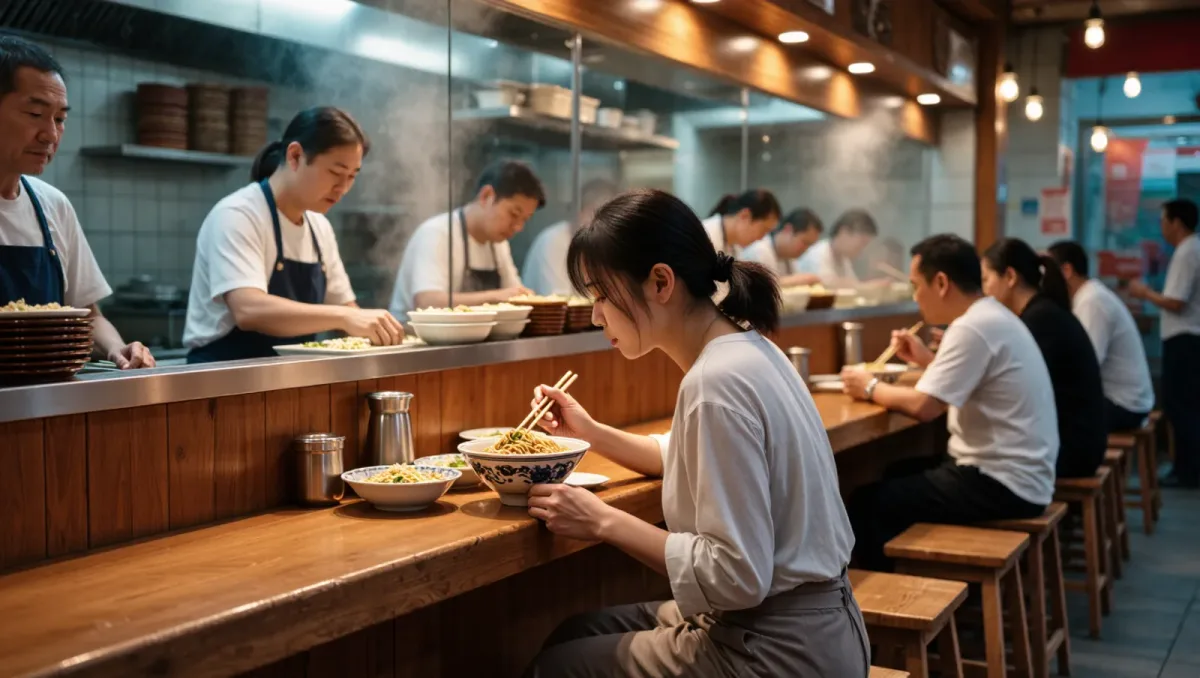
Japan built a retail category around the solo diner — the ochasen system of ticket machines at ramen counters, the one-person booths of kaiten sushi chains — a culture BBC Worklife has examined in its reporting on the country's solo economy. Elsewhere the single cover ranges from unremarkable, as at any Paris zinc, to nearly impossible without a reservation strategy, as at a packed Barcelona tapas bar on a Saturday. For the increasing number of people who travel alone — and plan trips around food — knowing where a table for one is a non-event changes both the itinerary and the trip.
This guide works through the world's major food cultures from the solo diner's side: where singles seat easily, where they seat at the counter, and where a little technique is required. It publishes information, not travel or booking advice.
Where is a table for one completely normal?
Japan is the global reference, from ramen counters to department-store basements, and its convenience is engineered rather than accidental: ticket machines remove the negotiation, counters remove the table problem, and solo booths remove even the gaze. Taiwan's night markets, Singapore's hawker centres and Vietnam's street stools all run on a similar principle — individual portions, fast turnover, no social contract requiring company. In these settings the solo diner is the default customer, not an exception to be accommodated.
Southern Europe is the pleasant surprise. A single Italian at the bar with a plate of pasta at lunch is ordinary; the Parisian tradition of eating at the zinc — standing at the counter, one plate, one glass — was built for exactly this. The pattern holds at lunch hours across Spain and Portugal, where weekday menús and pratos do dia fill with workers eating alone between shifts.
Where does solo dining need technique?
The dinner hour is the dividing line. In much of Spain and Latin America, dinner is a social act that starts late; a solo diner at nine o'clock sits comfortably, but the room is organized around groups — which makes the bar and the media ración counter the solo diner's real seating chart. In the United States, casual rooms seat singles easily, while tasting-menu rooms treat the counter as the solo seat — often the best seat in the house. In much of the Middle East and South Asia, communal platters assume a group; solo travelers do best at bakeries, canteens and grills with counter service, and a meal ordered as several small dishes rather than one shared spread.
Does the counter seat change the meal?
Usually for the better. The omakase counter, the ramen counter, the tsukemen stand and the chef's-counter tasting all address the single diner directly — the chef cooks in front of you, and conversation, when it happens, is with the kitchen. Food-industry observers have noted for years that counter seats are increasingly claimed by solo diners precisely because the format values them, per the wider reporting on solo dining's normalization. A solo traveler booking any counter-format restaurant should expect the best, not the residual, seat.
What are the practical rules that help everywhere?
- Eat at local hours. A 13:00 lunch or a 19:00 dinner in a late-dining country guarantees a seat and staff attention; arriving between shifts does the opposite.
- Bring a book or a notebook where dining is slow. In France, Italy and Portugal the single diner reading is a fixture; in fast-counter cultures nothing is needed at all.
- Reserve under one cover honestly. Tasting-menu rooms ask for party size anyway; solo covers are routinely welcomed and occasionally seat at a discount of sorts — the counter.
- Use bar and counter hours. Tapas at the bar, cicchetti in Venice, tachinomi standing bars in Osaka — standing formats belong to solo diners by design.
- Learn the local word for it. Hitori in Japan, solo across Latin America, per uno in Italy — naming the party size without apology sets the tone.
Is solo dining still stigmatized anywhere?
Less every year, and unevenly. The stigma that remains is social rather than operational — a feeling, not a locked door. The structural barriers that once mattered, minimum spends and two-cover reservations, have loosened across the industry as solo travel grew through the 2010s and 2020s, per industry reporting on solo travel's expansion. The working assumption for 2026: in the world's great food cities, the only real question is where the solo seat is best — and increasingly, it is the counter.