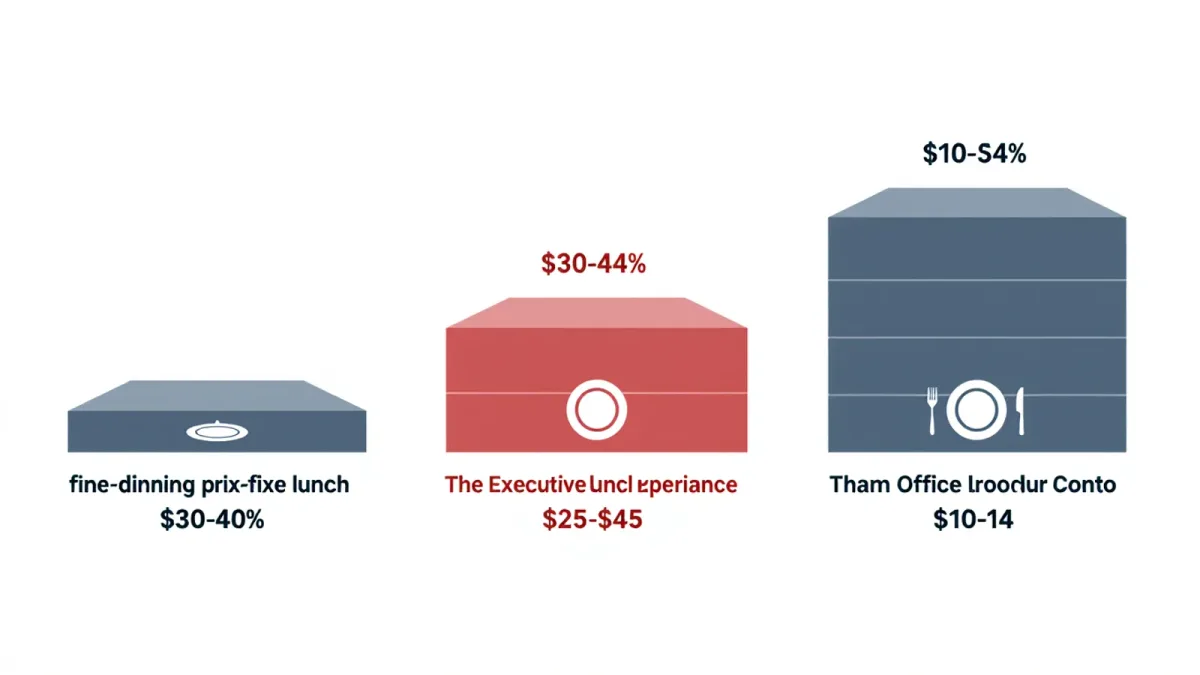
At noon the bistrot fills with people who work nearby, the chalkboard goes out front, and the formule begins: in 2025 the French working lunch commonly cost between €13 and €19 for two courses, €16 to €25 for three, per published menus checked across French cities — a price kept humane by a system every regular knows. The formule midi is the midday set formula, plat du jour at its center, built for the French lunch hour that remains, against the desk-sandwich tide, a proper seated meal — supported in part by the titres-restaurant, the meal-voucher system that millions of French employees use at exactly these counters, per the scheme's own institutional history.
What is a formule midi, exactly?
A lunch-only menu formula with fixed pricing and little choice — usually plat du jour plus a starter or dessert, with the three-course menu adding a few euros. The plat du jour is the day's single dish, decided by the market and the chef's mood: blanquette on Monday, pot-au-feu in winter, whatever the fish market gave on Friday. The chalkboard changes daily by design; a bistro whose board never changes is telling you the formule is decoration. Coffee — un café — often closes it, included or near-free, per the conventions of the format.
Why does the French lunch still work this way?
Because the institutions hold. The French lunch break runs long enough to sit down — legally and culturally — and the meal-voucher system channels a workforce into neighborhood restaurants every midday, an arrangement France formalized in the 1960s and expanded since, per the history of the titres-restaurant scheme. For restaurants, the formule fills the noon turn at thin margins and buys the evening's freedom; for diners, it prices the kitchen's real cooking below the tourist-facing card. Everyone wins at 12:30, which is why the format survives.
How does a traveler work the formule?
The rules are simple and generous. Arrive between 12:00 and 12:45 — the French hour is sharp, and kitchens open at noon sharp; at 13:45 you take what remains. Read the chalkboard, not the laminated menu. Say you will take the formule without embarrassment; the room was built on it. Ask what the plat du jour is — the recitation is half the ritual — and order the carafe d'eau, the free tap water every table is entitled to, per French restaurant custom. One hour later you have eaten the region's actual lunch at less than half the evening price.
Where does the format show best?
- Lyon. The bouchons — the small, unhurried tables particular to Lyon — run the country's most characterful midi formulas: oeuf en meurette, andouillette, the silkworkers' dishes at lunch prices.
- Paris's working quarters. The 10th, 11th, 12th and 14th arrondissements keep the true formule culture; the postcard streets monetize a postcard version.
- Provincial market towns. Where the market sets the plat du jour at 9:00, the formule is at its most local — the Dordogne, the Aveyron, Alsace's wine villages.
- Port cities. Marseille's midi tables serve the day's fish as the formula, a rhythm the vieux-port institutions have kept for generations.
What does it cost by city?
In 2025, published formules ran roughly €13 to €17 in provincial towns, €15 to €22 in Lyon and Marseille, and €16 to €25 in Paris, with the grand boulevards above that, per menu listings in 2025. Wine in a pichet — the small pitcher — adds a few euros; coffee may be included. The arithmetic beats any quick-service alternative in the same neighborhood, which is the quiet argument of the format.
The practical details
No reservations at most midi tables — walk in with the workers. Confirm whether service is included in the price; French menu prices carry service by law, per French hospitality practice, and the round-up remains the tip. Weekend formules thin out — the format is a weekday institution — and August rearranges whole neighborhoods, per the French holiday calendar. Prices cited here reflect 2025 menus; the chalkboard, as ever, is the current edition.