In Hong Kong the workday's first deal has long been struck over yum cha — morning dim sum with tea, before offices even open — a rhythm the city's teahouse culture has set for generations, per well-documented accounts of Cantonese yum cha custom. Across Asia's business capitals the midday meal is not a break from negotiation but an instrument of it: a choreography of seating, pouring, sharing and timing that signals respect before a single contract term is spoken. For the business traveler — or the curious one — the rules are learnable, and they differ sharply from city to city.
This guide works through the major business-lunch cultures of East and Southeast Asia: what the meal looks like, what the etiquette signals, and how a visitor eats well inside it. It publishes information, not business advice.
Hong Kong and Guangzhou: yum cha and the round table
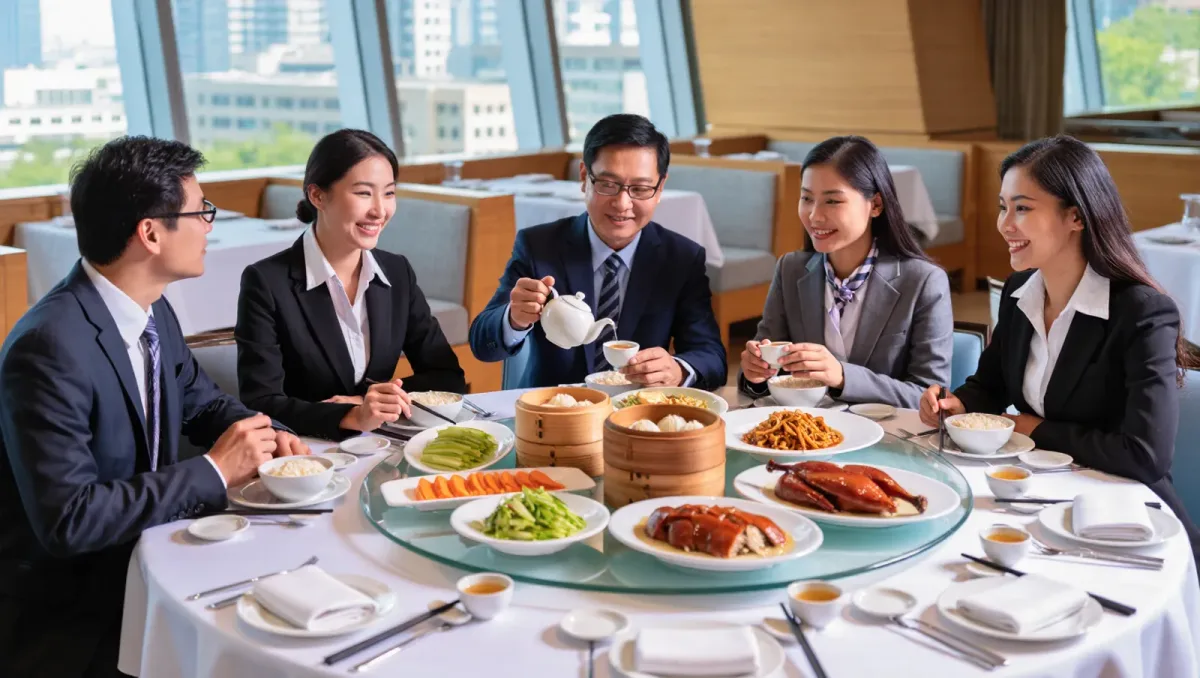
The Cantonese business meal is shared by design. Dishes land center-table and are rotated, ideally toward the guest of honor; the host orders, pours and pays. Dim sum versions run from trolleys to order sheets; a serious yum cha lunch takes its time, and declining the second pot of tea is a gesture, not a preference. Cards are exchanged with both hands, text toward the recipient, and read before pocketing — a formality that carries across the region, per standard business-etiquette guidance.
Tokyo: the teishoku lunch and the quiet hour
Japan's business lunch runs on the teishoku set — rice, soup, grilled fish or the day's main, pickles — at lunch-set prices dramatically below dinner, a structure long standard in Tokyo's office districts. The etiquette is quiet rather than elaborate: punctuality bordering on ritual, no pouring your own drink without offering to pour for others, and itadakimasu before eating. The famous business custom — cards again two-handed — matters less than timing: the 12:00 hour fills instantly, and a table booked for 11:30 or 13:30 says as much about competence as the order does, per the working rhythm of Japanese office districts.
Singapore: hawker power lunches
Singapore collapsed the formality decades ago. Deals are brokered at hawker centre tables over chicken rice and laksa — shirtsleeves, tissue packets as seat reservations, fast decisions. The etiquette is light: the host orders for the table, queue-jumping is the one unforgivable sin, and clearing your tray is law by regulation, per the city's public-housing and environment rules on hawker-centre conduct. Of all Asia's business lunches this is the most accessible to a visitor — the format welcomes anyone who queues.
Shanghai and Beijing: the banquet logic in miniature
Even at lunch, northern and eastern Chinese business meals keep banquet grammar: a lazy Susan, the host facing the door, the guest of honor at their right, tea poured for others before yourself, and gentle insistence — offering once is not offering. Toasts at lunch are softer than at dinner but present; tapping two fingers accepts a pour with thanks, per widely documented Chinese dining etiquette. The private-room lunch remains a real institution, and business travel to China that skips it misses the meal where relationships — guanxi — are actually serviced.
Seoul: quick, hot and hierarchical
The Korean business lunch bends to speed and seniority: everyone eats together and fast — jjigae stews, bibimbap, the office-district dosirak — with seating and the first bite deferred to the most senior present, per standard Korean dining etiquette. Soju stays at dinner; lunch is tea, water, sometimes coffee after. The meal ends when the senior ends it, and the bill is settled by rank without discussion.
What can a visiting traveler take from all this?
- Let the host lead — seating, ordering, pouring, paying. Refusing the lead is the respect.
- Match the pace. Fast in Singapore and Seoul, unhurried in Hong Kong, silent in Tokyo.
- Learn the pour. Across the region, you pour for others, never only yourself.
- Take the 11:30 or 13:30 slot where offices run on reservations — the prime 12:00 hour is booked by people who plan.
The practical details
For business travelers: cards in good condition and carried for two-handed exchange; dietary restrictions declared to the host discreetly in advance, never at the table; and lunch budgets confirmed by whoever hosts, since the insistently-paying tug-of-war is a ritual, not a negotiation. Customs summarized here reflect documented etiquette guidance and dining practice as of 2025.