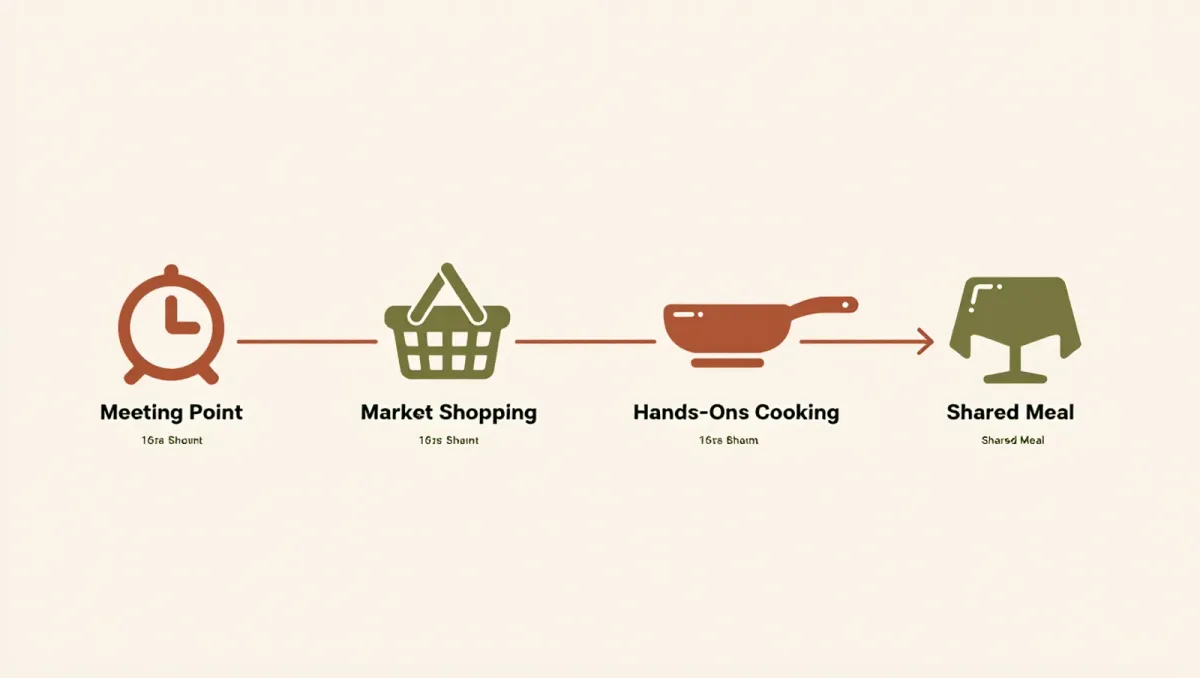
A cooking class abroad is one of travel's most predictable pleasures: the standard format runs three to five hours, costs roughly $50 to $150 per person depending on country, and follows the same arc — meet, shop or pick, cook, and eat what you made — whether the kitchen is a Tuscan farmhouse, a Bangkok street-food wok station, or a family kitchen in Oaxaca, based on published schedules of cooking schools across major destinations as of early 2026.
This guide explains the mechanics behind that arc: the types of classes and who they suit, how booking and confirmation actually work, what happens hour by hour, what is expected of you — and what is expected of the school — plus the details, from recipe handouts to tips, that listings forget to mention.
What kinds of cooking classes exist?
Four formats cover the market. Market-to-table classes begin with a guided shop — the ingredients you buy, you cook — and dominate cities from Barcelona to Hoi An. Home-cook classes teach in a family kitchen, usually the most intimate and often the cheapest; platforms connecting travelers with home cooks have made them bookable everywhere from Lisbon to Jaipur. Professional-school classes run out of dedicated teaching kitchens with multiple stations and printed curricula; the trade schools of Paris, Bangkok, and Chiang Mai lead here. Destination formats — farm classes, vineyard lunches with cooking, fishing-village days — bundle the class into a half-day excursion.
The format decides the day. A market-to-table class spends its first hour shopping; a school class spends it on knife skills. Neither is better — but a traveler who hates crowds at wet markets should know what the first hour holds.
How do you book, and when?
Direct booking with the school beats platform booking on price and on communication — the school answers your questions, not an intermediary — while platforms add reviews, cancellation insurance, and last-minute inventory. Book one to three weeks ahead in high season, a few days ahead otherwise; the best-reviewed classes in small kitchens run at capacity in summer and December. Confirmation should state: group size, meeting point, duration, menu, inclusions (meal, drinks, recipes, aprons), and the cancellation window — most day classes refund fully up to 24–72 hours before, though terms vary and should be read, not assumed.
Dietary declarations belong in the booking message, not on arrival: vegetarian is almost universally accommodated, vegan and serious allergies need a written exchange with the kitchen, and the answer arrives fast at a well-run school.
What does the class day look like?
The arc, hour by hour. Meeting: at the school or a market gate, 15 minutes of introductions and coffee or tea. Shopping or gathering: 30–60 minutes where included, with the instructor explaining selection — which bananas for the cake, which chile for the paste. Cooking: 90 minutes to three hours, hands on. Students do the work in pairs or singly at stations; the instructor demonstrates each step, and the honest test of a school is how much of the work is yours. Eating: the meal you made, served with the drinks included, typically the longest and best hour. Clean-up belongs to the staff almost everywhere; a school that expects students to wash up has made its choice and says so in the listing.
What should you expect the school to provide?
The standard kit: aprons, equipment, ingredients, printed or digital recipes, the meal, and non-alcoholic drinks; alcohol is included at some schools and sold or BYO at others — the listing says which. Recipe handouts deserve a check: a school confident in its teaching sends you home with the dishes' full method, ideally by email after class rather than a leaflet of ingredients only. English instruction is common in tourist centers but not universal; listings that teach in the local language with an interpreter say so, and classes without shared language still work — cooking is showable — but a nervous cook should confirm the language before booking.
What is expected of you?
Three things, mostly social. Punctuality: market classes leave the meeting point at the stated time, and a group waits for no one past ten minutes. Participation: the class is not a demonstration — hands go in the dough, and the students who hold back regret it at the table. Openness: dishes get made differently than at home, and the instructor's way is the class; arguing a recipe is a scene, asking why is a lesson. Beyond that, normal etiquette: tell the school of allergies in advance, warn of late arrival, and cancel in time so the market shopping is not wasted.
What about tips, kids, and leftovers?
Tipping varies by country and follows local restaurant norms: appreciated but unremarkable in much of Europe, expected in the United States, folded into the culture elsewhere — 5–10% at a class you loved is generous in most destinations. Children: many schools take them from about 8–12 with a paying adult, and family formats exist in Italy, Thailand, and Mexico; ask directly, since listings understate this. Leftovers: eat them — most schools box what you cannot finish, and a few farm classes send you home with preserves made in class. Bring a bag regardless; the bottles of wine from vineyard classes do not carry themselves.
Which destinations teach best?
The strongest teaching cuisines share two traits: home technique that transfers to a simple kitchen, and markets that make the shopping worth watching. That puts Thailand, Vietnam, and India at the front — market-to-table classes with bold, learnable technique — alongside Italy and Mexico, where the pasta line and the mole line are both teachable in an afternoon. France and Japan teach beautifully but reward longer formats; a one-day sushi class covers rice, not craft. Wherever you book, choose a class teaching a cuisine you will actually cook again — the meal ends, the recipes stay.
Frequently asked questions
How much does a cooking class abroad cost? Indicative 2026 ranges: $25–$60 in Southeast Asia, $50–$100 in most of Europe, Latin America, and India, and $100–$180 for professional-school and vineyard formats in premium destinations.
Do cooking classes work for non-cooks? Yes — that is who most schools teach. Instructions are step-by-step, stations are supervised, and the meal at the end does not require a single learned skill, only a working afternoon.
Can you take a class on your first night in a country? Better not. Market classes assume enough orientation to enjoy the shopping, and jet-lagged hands chop carelessly. Day two or three, after the local food has context, is the sweet spot.
Are recipes provided? At good schools, yes — printed at class or emailed after, with full methods rather than ingredient lists. Ask at booking if recipes matter to you; the answer sorts the serious schools from the assemblies.