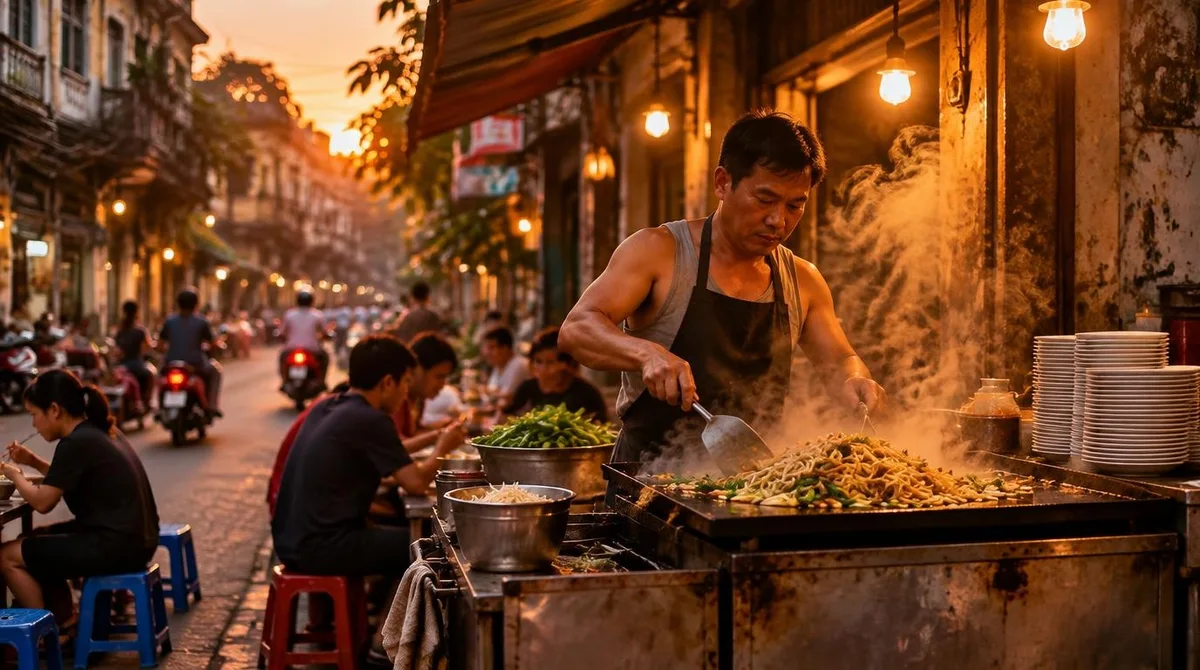
Vietnamese street food is built on a simple trade: a vendor does one dish, does it all day, and does it for the price of a coffee back home. The traveler's job is to find the right pavement stool and order with confidence. The qualification worth knowing first: the best stalls are often morning-only or evening-only, and the popular ones sell out.
This guide covers the dishes that earn the trip, the ingredients that make them sing, and the small etiquette of eating street-side. It also covers the handful of words that change the experience — a Vietnamese phrase guide for beginners recommends starting with just five: xin chào (hello), cảm ơn (thank you), dạ (a polite yes), bao nhiêu? (how much?), and tôi không hiểu (I don't understand).
Which dishes should a first-time visitor order?
Start with the classics, in the order most palates handle them. Phở — the rice-noodle soup with beef broth, herbs, and lime — is the entry point, eaten at low plastic tables, often at breakfast. Bánh mì is the portable counterpoint: a crisp baguette split and filled with pâté, pickled vegetables, coriander, and whatever protein the stall specializes in. It is the rare street food that travels well, which makes it the standard lunch on the move. For related coverage, see Food Open Near Me — Late-Night Eats: Where Locals Go After Midnight.
Beyond those two, the field opens up. Bún bò Huế is a spicier, more assertive noodle soup from the former imperial capital. Gỏi cuốn — fresh spring rolls of pork, shrimp, and herbs wrapped in rice paper — are the light option on a hot day. Bún chả pairs grilled pork with noodles and a bowl of dipping broth, and it is famously a lunchtime dish rather than an all-day one. The pattern to notice: most vendors cook one thing. A stall with a short menu and a queue is doing it right.
What exactly is in the bowl?
Vietnamese cooking leans on a few load-bearing ingredients, and knowing them helps a traveler order and adjust. Fish sauce (nước mắm) is the backbone of broths and dips — salty, not fishy once cooked. Rice noodles come in widths matched to the dish: thin for phở, thicker for others. Fresh herbs — coriander, Thai basil, mint, sawtooth coriander — arrive as a plate alongside most noodle dishes, meant to be added by the eater, not the cook.
Then there is the condiment caddy on every table: chili paste or fresh chilies, lime wedges, and sometimes vinegar-soaked garlic. The phrase guide noted above is useful here too — không cay means "not spicy," and tôi ăn chay tells a vendor you are vegetarian. Both are worth memorizing before the first bowl arrives. The herbs and garnishes are the adjustable part of the meal; the broth is the vendor's signature and should be tasted before anything is added.
Where do you find the good stalls?
The reliable signals are universal enough to state plainly. Look for a single dish, cooked in view, with a steady local queue. Locals eating there at the dish's proper hour — soup in the morning, grilled pork at lunch — is the strongest endorsement a stall can carry. Where a dish is tied to a place, follow the geography: bún bò Huế is at its home best in Hue, and a city's own specialty will usually beat its exported version.
Abroad, the same logic applies with one adjustment. Diaspora communities have carried these dishes to cities worldwide, and the best versions abroad tend to cluster where a Vietnamese community actually shops and eats, rather than where the signage is most polished. Readers planning a broader eating trip can compare the approach in Food Places Near Me: How to Find the Best Local Food Trucks in Any City — the principle of following the local queue transfers cleanly. And for evening hunting, the late-night eats guide covers the after-dark shift, which in Vietnam belongs to grilled-meat stalls and noodle vendors who open when the day crowd has gone home. This connects to our earlier piece, Food Places Near Me: How to Find the Best Local Food Trucks in Any City.
How do you eat street-side without causing a scene?
Etiquette at a Vietnamese street stall is light on rules and heavy on courtesy. Greet the vendor when you sit — xin chào with a smile does more work than any tip. Pointing at what the neighbors are eating is an accepted ordering method, and cho tôi ("I'll have...") plus a gesture completes it. The phrase guide's list covers the rest of the transaction: bao nhiêu? for the price, ngon quá! ("so delicious!") as the compliment, and tính tiền to ask for the bill.
A few practical notes. Napkins are often a small paid packet rather than a free pile — accept that. Chopsticks lift the noodles; the ceramic spoon handles the broth; drinking directly from the bowl is normal and nothing to apologize for. Payment is usually cash, handed over with both hands or the right hand as a small politeness. And the pronoun system matters: Vietnamese address changes with the other person's apparent age and gender, which is why dạ — the polite yes — earns its place among the first five phrases to learn.
What does street food actually cost — and is it a fair price?
The honest answer on value: street-side eating in Vietnam is the cheapest good meal a traveler will find anywhere, and the pricing is transparent in a way restaurant menus rarely are. There is no service charge, no markup theater, no menu psychology — the vendor names a price, and bao nhiêu? gets it stated before the bowl arrives. Readers who enjoy taking menus apart will find the contrast developed in How to Read a Menu Like a Chef; the street stall is the anti-menu, and that is the point of it.
Our analysis, stated plainly: the value is real, and so is the labor behind it. A bowl that costs less than a bus fare represents hours of stock-making that started before dawn. Paying the asking price without haggling — this is food, not a market souvenir — is both the etiquette and the arithmetic. The meal is already the best deal on the trip.
The takeaway for a food-first trip
Vietnamese street food rewards a specific kind of travel planning: go at the dish's hour, order its one specialty, keep a few phrases ready, and let the queue make the decision. The evidence a traveler can rely on is visible — the vendor's single pot, the neighbors on the stools, the herbs on the side plate. What remains unknown is only which stall will become the trip's memory, and the only way to settle that is to keep eating.