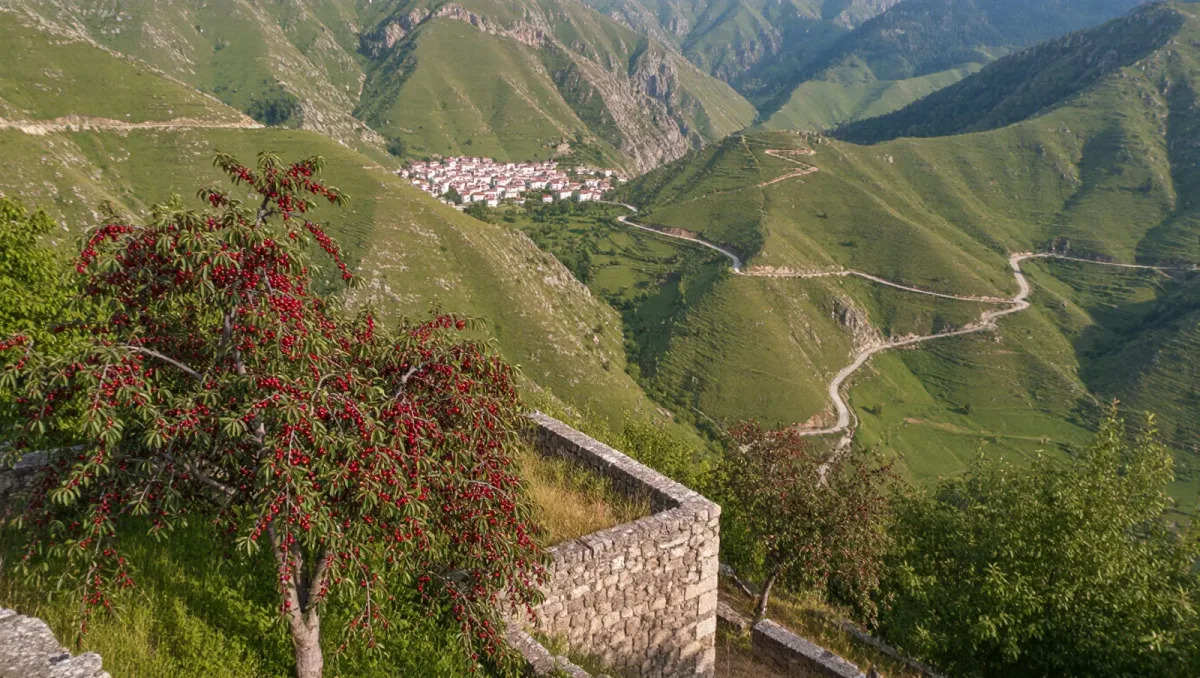
The Valle del Jerte, a green fold in the mountains of northern Cáceres in Extremadura, western Spain, holds an estimated 1.5 million cherry trees on terraces climbing from the river to nearly 1,200 meters, and for a few weeks each June the valley harvests them in earnest: the local Picota — a sweet cherry that ripens with no stem at all, separating cleanly from the branch — reaches its season just as Spain's supermarkets take it nationwide under the valley's Protected Designation of Origin, the first Spanish fruit to hold one.
This guide explains what the Jerte cherry is and why the stemless Picota matters, when each variety ripens, how a harvest-season visit works — roadside ventas, village ferias, and the gorge pools the pickers swear by — and where to stay while the trucks run. Details reflect current designation-body and regional tourism sources as of early June 2026.
What is a Picota, and why is it different?
The Picota group — principally the Ambrunés variety — is the valley's flagship: a firm, dark, intensely sweet cherry whose peduncle dries and detaches at full ripeness, so it falls stemless from the tree and is harvested without one. That trait is the valley's signature and the reason the fruit travels and keeps unusually well. The designation covers the eleven villages of the Jerte and neighboring Ambroz valleys and several neighboring varieties — Navalinda, Burlat, Van, Lapins among them — that extend the season from late April into late July, with the Picota itself filling June and July.
Taste the difference at a roadside venta: early Burlat and Van cherries are juicy and mild; a ripe Ambrunés Picota is denser, crunchier, and distinctly more concentrated — the one locals buy by the ten-kilo crate to preserve in aguardiente.
When is the season, exactly?
The valley's calendar runs in two movements. In late March and early April, roughly a million trees flower at once — the Fiesta del Cerezo en Flor, the blossom festival, draws visitors from across Spain and turns the valley white for about two weeks, with the exact peak shifting with the year's weather. Then comes the harvest: Burlat from late April, the mid-season varieties through May, and the Picota from early or mid June into late July, with the highest terraces ripening last. By mid-June — now, at the start of the Picota window — the roadside trade is in full swing.
A visit in June beats a visit in April for eating and loses nothing in scenery: the fruit hangs heavy, the ventas are stocked, and the mountain villages have their ferias.
How do you visit during the harvest?
The valley's social road — the N-110 from Plasencia to Tornavacas, mirrored by the older EX-203 — becomes one continuous fruit market in June: family ventas under awnings at the roadside, crates of cherries sorted by variety and altitude, cherries in licor, and the valley's second crop, the Jerte's raspberry plantings, beside them. Prices at the venta run a fraction of city fruit-shop rates — typically €3 to €6 a kilo depending on variety and week — and the growers sell what they picked that morning.
Several villages organize open-farm days and tastings through the season, coordinated by the designation's regulatory council and the comarca's tourism office; the cherry cooperative in El Torno and the visitor points in Navaconcejo and Cabezuela del Valle post the week's schedule. Wear shoes for mud at the terraces, and buy in the morning — the best lots move before the day heats up.
What else does the valley hold?
The Garganta de los Infiernos nature reserve crowns the valley head: a granite gorge where the Jerte river runs through a stair of pools — Los Pilones — carved smooth enough to swim in, reached on foot from Tornavacas through chestnut and cherry country. The villages themselves carry the region's half-timbered, chestnut-beamed architecture: Cabezuela del Valle hosts the cherry interpretation center, El Torno its cooperative and the famous licor de cereza, and Tornavacas, at the valley's head under the Tornavacas pass, keeps the grandest houses — wealth built on the fruit trade's heyday.
Plasencia, twenty minutes north, supplies the practical base: a 15th-century cathedral doubling with its 16th-century successor, a functioning old quarter, and the restaurants where the valley's cherries finish the menu in season — clafoutis, cold soups, and simply a chilled bowl of Picotas.
Where does the fruit go, and can you take some home?
The designation's harvest runs to tens of millions of kilograms in a good year, most of it sold within Spain in the weeks it ripens; the stemless Picota's shelf life is what makes the national campaign possible. For travelers, cherries are the perfect souvenir that isn't: eat what you buy in-country, since fresh fruit faces restrictions at most borders, and carry the shelf-stable versions instead — licor de cereza, cherry jam, and dried cherries travel without customs questions. The mechanics of packing edible souvenirs, from wax cheeses to jars, are covered in our guide to packing gourmet souvenirs.
How does a harvest day unfold?
Start at the venta by nine, when the first crates of the morning are still in shade and the growers have time to talk varieties; buy for the day, not the week — the Picota keeps better on the tree than in your trunk. By late morning, walk or drive to a terrace finca where open-farm visits are scheduled, or head up to the gorge pools before the heat. Eat the long lunch Plasencia style, and end in a village plaza where the June ferias set up their grills and their licor-tasting tables. Two days cover the valley comfortably; three let you add the neighboring La Vera, whose smoked paprika — pimentón de la Vera, another protected designation — belongs in the same car trunk of Spanish reds.
One seasonal note rounds the picture: the valley's raspberry plantings and the gorge's wild herbs feed a small parallel kitchen of farm restaurants, where June menus pair cherries with local lamb and the Vera's smoked paprika. If a menu offers the valley's trout from the upper river, take it — it is the old Jerte dish, and the season's best argument for staying the night.
Frequently asked questions
When is the Jerte cherry blossom? Late March to early April, peaking for about two weeks; the Fiesta del Cerezo en Flor dates move with each year's bloom. Blossom season books valley rooms early.
What is a picota cherry? A group of varieties — chiefly Ambrunés — that ripen with no stem, detaching cleanly from the branch. Firm, dark, and sweet, they are harvested stemless and fill the June-July window of the valley's protected designation.
Can you swim near the cherry villages? Yes — the Los Pilones pools in the Garganta de los Infiernos reserve are the valley's famous swimming gorge, a walk from Tornavacas, cold, clear, and best in June before the high summer crowds.