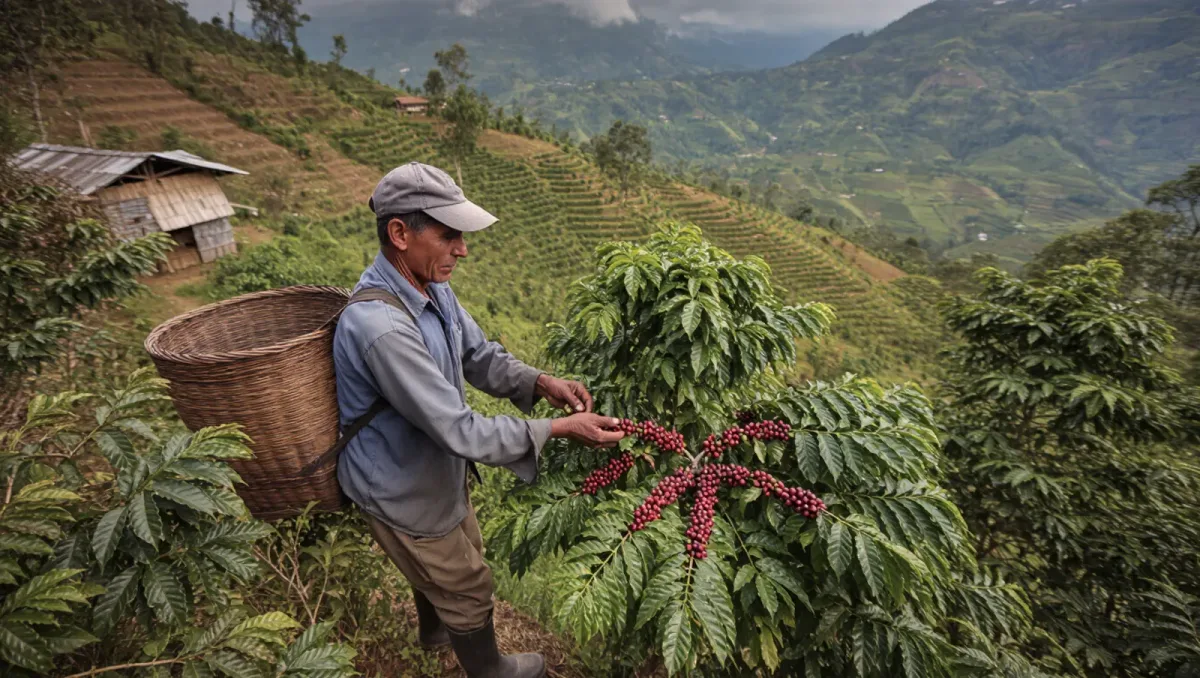
The Colombian Coffee Triangle — the Eje Cafetero spanning the departments of Caldas, Risaralda, and Quindío in the central Andes — is a working agricultural landscape UNESCO inscribed in 2011 as the Coffee Cultural Landscape of Colombia, an area where hundreds of thousands of smallholder farms grow arabica on the steep slopes between 1,200 and 1,800 meters, and where a traveler can sleep on the same fincas that pick, pulp, dry, and ship the beans.
This guide covers the practical visit: which towns anchor a route, what a farm stay includes, how the harvest calendar works in a country that flowers and picks year-round, and how the coffee itself is drunk at origin — black, sweet, and in a tinto cup that costs pocket change. Details reflect published federation and tourism sources as of mid-2026.
What and where is the Coffee Triangle?
The triangle's vertices are the cities of Manizales, Pereira, and Armenia, an hour or so apart by road on the central cordillera, with the smaller heritage towns doing the visiting: Salento and Filandia in Quindío, Jardín and Támesis to the south in Antioquia's borderlands, Thermia and the hacienda country above Manizales. The landscape's signature is the combination of bamboo-and-adobe farm architecture, shade-grown coffee on impossibly steep fields, and the cloud forest ridges between — including the Cocora Valley, where Quindío wax palms, the world's tallest palms and Colombia's national tree, rise to 60 meters.
Coffee came here in the 19th century, and the Federación Nacional de Cafeteros — the growers' federation, founded in 1927 — organized the extension network of cooperatives, mills, and extension agents that still defines rural life. Colombia remains among the world's top three producers, essentially all of it arabica, essentially all hand-picked.
What does a finca stay actually involve?
The triangle's farm stays range from working farms with three guest rooms to full hacienda-hotels with pools and horse stables. A typical two-night stay includes the morning farm tour — nursery, picking, the wet mill where cherries are pulped and fermented, and the drying patios or mechanical driers — plus meals cooked farm-style: arepas, calentado, fresh fruit, and endless tinto. Prices in 2026 run roughly COP 150,000–400,000 per person per night with meals (about US$35–95) at mid-range fincas, more at the design-led haciendas; booking direct with the farm or through the region's farm-tourism associations is standard, and weekends fill with Colombian families, so midweek visits are quieter.
Depending on the season, guests pick: a baskets-and-willis day in the harvest, with a strap woven basket and the picker's rule — only the deep-red cherries — that explains why Colombian coffee is hand-sorted. Nobody picks a full canasta on a first morning, and the pickers who do are paid by the kilo.
When is the harvest?
The triangle's latitude and dual rains make it a two-harvest landscape: the main harvest (cosecha) falls roughly October to January in the northern triangle, with a secondary fly crop (mitaca) around April to June, and the exact months shift with altitude and farm. The practical translation for travelers: some picking is visible on almost any finca at almost any time of year, but the main-harvest months show the whole machine running — washing stations at capacity, drying patios full, and the rural roads busy with the red-bean jeeps (Willys) hauling sacks to the co-op. Book finca rooms well ahead for December, when Colombian holiday travel overlaps the peak.
How is coffee drunk at origin?
As tinto: black, small-cupped, and heavily sweetened, sold from thermos flasks on every street corner for a fraction of a dollar and consumed all day by everyone — a habit that surprises visitors expecting café con leche ceremony. The triangle's specialty scene has grown on top of the tradition: Armenia, Pereira, Manizales, and Salento now host cupping rooms and barista cafes pouring the same farms' washed caturra, castillo, and pink bourbon lots by the pour-over. A cupping session at a farm or co-op — often free with a tour, a few dollars in town — teaches the difference between the origin's classic caramel-and-citrus profile and the newer fermentation-driven lots.
Buying at origin is easy and worth doing: cooperative shops and finca counters sell roasted lots by the 250-gram bag at supermarket-or-better prices, vacuum packed and travel-proof.
Beyond the finca: what fills the other days?
The region packs a surprising amount around the coffee. The Cocora Valley hike from Salento runs cloud forest and palm groves in a half-day loop; the thermal springs at Santa Rosa de Cabal and Thermia heat the mountain evenings; Jardín's orchid-decked balconies and cable car belong to the prettiest town squares in Colombia; and Manizales keeps its 1930s cathedral tower and the university-city edge that makes it the triangle's most livable city. Between them, the Willys jeeps still run rural bus routes — stand on the running board at your own risk and enjoyment.
Practical summary
- Base: Salento or Filandia for Quindío scenery; Manizales or Pereira for access and city evenings.
- Stay: two nights on a working finca with meals; midweek beats weekends; December books earliest.
- Drink: tinto on the street, cupping at the co-op, a pour-over of pink bourbon in Salento.
- Season: main harvest October–January, mitaca April–June; picking visible nearly year-round.
- Pair: Cocora Valley, Santa Rosa thermal springs, Jardín day trip.
One practical caution rounds out the logistics: the mountain roads between towns are slow, and the region's distances are deceptive — allow an hour for hops the map says are thirty minutes, and let the Willys, colectivos, and hotel shuttles do the driving after tasting sessions. Rain arrives most afternoons even in the dry months; the finca veranda with a cup and the valley below it is exactly what the pause is for.
A final note for planners: the region's distances deceive — mountain roads between towns run slow, and a hop the map shows as thirty minutes can take an hour. Let the Willys jeeps, colectivos, and finca shuttles do the driving after tasting sessions, and expect afternoon rain even in the dry months. The veranda pause it forces — a fresh cup, the valley below, the mist climbing the palms — is not an obstacle to the itinerary. It is the itinerary.
Frequently asked questions
Is the Coffee Triangle safe for travelers? The main tourist corridor is heavily visited and the towns listed here have stable tourism economies; standard Colombia precautions apply, and current government travel advisories should be checked before booking.
Can you visit the Cocora Valley and a coffee farm in one day? Yes — the valley loop is a morning hike and fincas run afternoon tours; most visitors give each its own day to avoid rushing the wax palms.
How do you get to the triangle? Daily flights reach Pereira, Armenia, and Manizales from Bogotá and Medellín in under an hour; buses take three to six hours from the same cities on good mountain highways.