White truffle season in Alba runs from early October to late January, but the weeks that matter to a traveler fall between October and the first days of December, when the Fiera Internazionale del Tartufo Bianco d'Alba — the international fair whose first edition dates to 1929 — turns this town of some 30,000 people in Piedmont's Langhe hills into the world capital of Tuber magnatum pico, a fungus that cannot be farmed and is priced by the gram.
This guide covers the practical mechanics of a truffle-season trip: the market where truffles change hands, how the daily price is set, what a truffle-hunt demonstration actually involves, and where the tuber ends up on a plate.
What exactly is the white truffle of Alba?
Tuber magnatum pico is a subterranean fungus that grows in symbiosis with the roots of oaks, poplars, and willows in the marl and limestone soils of the Langhe, Roero, and Monferrato — a landscape UNESCO inscribed as a World Heritage site in 2014 partly for this reason. Unlike the black truffle, it has never been successfully cultivated: it appears where it appears, under the same trees season after season, and only a trained dog can find it. The name "tartufo bianco d'Alba" is protected under the EU's Protected Geographical Indication scheme, meaning only tubers harvested in designated zones of Piedmont and neighboring regions may carry it.
The fresh truffle is pale ochre to hazel, smooth-skinned, and smells of garlic, honey, and wet earth — a aroma that fades within days of harvest, which is why the entire trade is organized around getting the tuber from forest to table fast.
When is the season, and when should a traveler arrive?
The regulated harvest season for Tuber magnatum pico in Piedmont runs from about September to the end of January, set by regional rules that protect the fungus's reproductive cycle. But the fair calendar defines the traveler's window: the Alba fair typically opens in early October and closes in early December. The three weekends of the Palio degli Asini and the fair's opening weekends are the busiest; November, when the harvest peaks, is the month locals consider the true heart of the season.
Arrive mid-October and the market is lively but manageable; arrive the first weekend of November and expect crowds, higher room rates, and the fullest program of tastings and auctions. By late December the fair is over, though a handful of Alba restaurants still serve fresh truffle until the season closes in January, weather permitting.
Where does the truffle market actually happen?
Two separate things share the name "Alba truffle market," and confusing them wastes a morning. The fair — with exhibitions, tastings, wine stands, and the sensory-analysis station — fills the town center and Cortile della Maddalena. The actual commerce happens in the Alba Regional Truffle Market hall on Piazza Beppe Fenoglio, where the town's own analysis center (Centro Analisi) checks every truffle for species, weight, and condition before it may be sold, and where a public price board posts the day's going rate per 100 grams, updated through the season.
Travelers can enter the market hall during public hours published by the fair, watch the weighing, and buy on the spot — most vendors vacuum-pack to order. Bring cash or a card with room on it: at typical in-season rates of roughly €250 to €400 per 100 grams (varying by quality and week, per the fair's bulletin), a truffle the size of a walnut is a three-figure purchase.
How is the price set — and why does it swing?
Unlike wine, truffles have no futures market. Each morning of the season, brokers and licensed harvesters — the trifolau, who must register with the province and hold a permit for specific hunting grounds — negotiate around the day's supply. The fair's price board reflects those deals, and cold, dry autumns that shrink the harvest push it upward; a rainy October can halve the price within two weeks. The record sums quoted in the press — truffles of exceptional weight sold at the annual charity auction in Grinzane Cavour, which has drawn bids from Hong Kong to New York since the early 2000s — are outliers, not the market.
For a traveler, the practical rule: ask to see the price board before you buy, check the analysis-center tag on the truffle, and treat any shop in the region quoting a fixed winter-long price with suspicion.
Can you actually go on a truffle hunt?
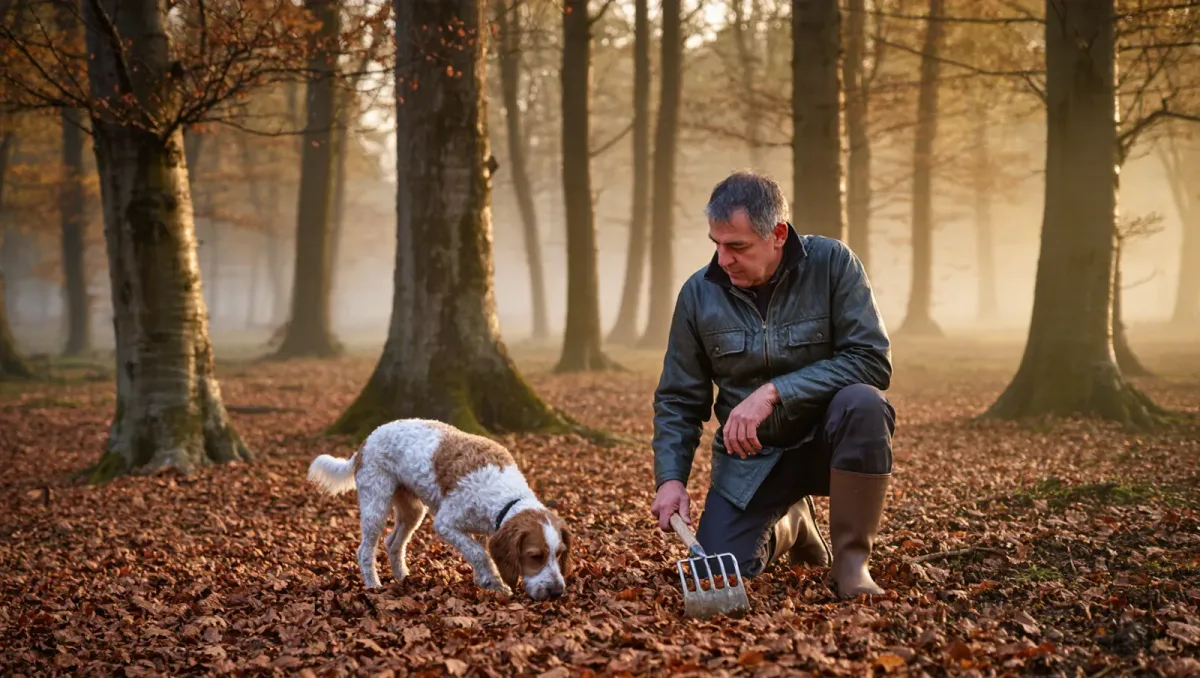
Yes, and it is the part of the season worth building a trip around. Across the Langhe — in La Morra, Barbaresco, Neive, Monforte d'Alba, and the Roero across the Tanaro river — registered trifolau offer guided hunts with their dogs, most famously the lagotto romagnolo, the curly-coated breed bred in the region for this exact job. A typical outing lasts one and a half to three hours, costs in the range of €50 to €150 per person depending on group size and duration, and ends, more often than not, with nothing dug up — which is the honest point. Guides affiliated with the fair's official program are vetted and book out weeks ahead in November; booking directly with a registered harvester a few weeks in advance is the realistic route.
Ethics matter here: the trifolau's grounds are his livelihood, and photography of specific locations is off-limits. A hunter who promises guaranteed finds is telling you something about himself.
How do Alba's restaurants serve it?
The house ritual is restraint. Tajarin — the yolk-gold hand-cut noodles specific to the Langhe — arrive at the table, and a shavings of truffle is grated over them at the table from a small metal plane, weighed before and after so the guest pays for exactly what landed. The same treatment meets uova con tartufo (fried eggs with truffle) and, in winter, bagna cauda's anchovy-garlic sauce as a counterpoint. Expect a cover of roughly €3 to €8 per gram of truffle, quoted per gram on the menu; a modest shaving of five grams is a €20-to-€40 supplement at mid-range tables, more at the region's destination restaurants.
Sensible ordering: choose the dish by the pasta, not the truffle. The tuber perfumes whatever carries it; the Langhe's egg-rich tajarin carries it best, and that is what three generations of Piedmontese families order on a November Sunday.
What else does a truffle-season trip to the Langhe include?
The region rewards drivers and slow eaters in equal measure. Alba itself — birthplace of both the Ferrero confectionery empire and the poet Beppe Fenoglio — anchors the trip, but the villages above it hold the reason to linger: Barolo and Barbaresco wine towns within twenty minutes, each with enoteche pouring by the glass; the castle of Grinzane Cavour, home to the region's first wine cellar and the truffle auction; and hazelnut country, since the Tonda Gentile delle Langhe nut behind gianduja grows on the same hillsides. Most visitors come for a long weekend; the roads are small, and November fog in the Tanaro valley makes an early-evening return to Alba the reliable plan.
Practical summary
- Season: harvest runs to end of January; the Alba fair runs early October to early December; November is peak.
- Market: the price-checked market hall operates on fair days; the analysis-center tag and public price board are your safeguards.
- Price level: roughly €250–€400 per 100 grams in-season, per the fair's bulletin; menus price truffle per gram.
- Hunts: registered trifolau with dogs, 1.5–3 hours, from about €50 per person; book weeks ahead for November.
- Order: tajarin al tartufo — the dish the hills invented for the tuber.
Frequently asked questions
Is the white truffle season over by Christmas? The legal harvest runs to the end of January, but the Alba fair closes in early December. After that, fresh truffle appears mainly on restaurant menus; the market hall reopens with the next fair.
Can white truffles be shipped home? Vacuum-packed truffle keeps a few days refrigerated; some vendors ship overnight within Europe. For intercontinental travel, check your own customs rules before buying — a fresh truffle is a perishable, not a souvenir that waits.
What is the difference between white and black truffle season? Black truffles (Tuber melanosporum) peak in winter, are cultivated in plantations, and cost a fraction as much. The white truffle is wilder, more aromatic, and never farmed — hence the premium and the dogs.
Do you need to book Alba restaurants during the fair? Yes, well in advance for November weekends; the fair draws an international crowd and the town's best tables fill first.