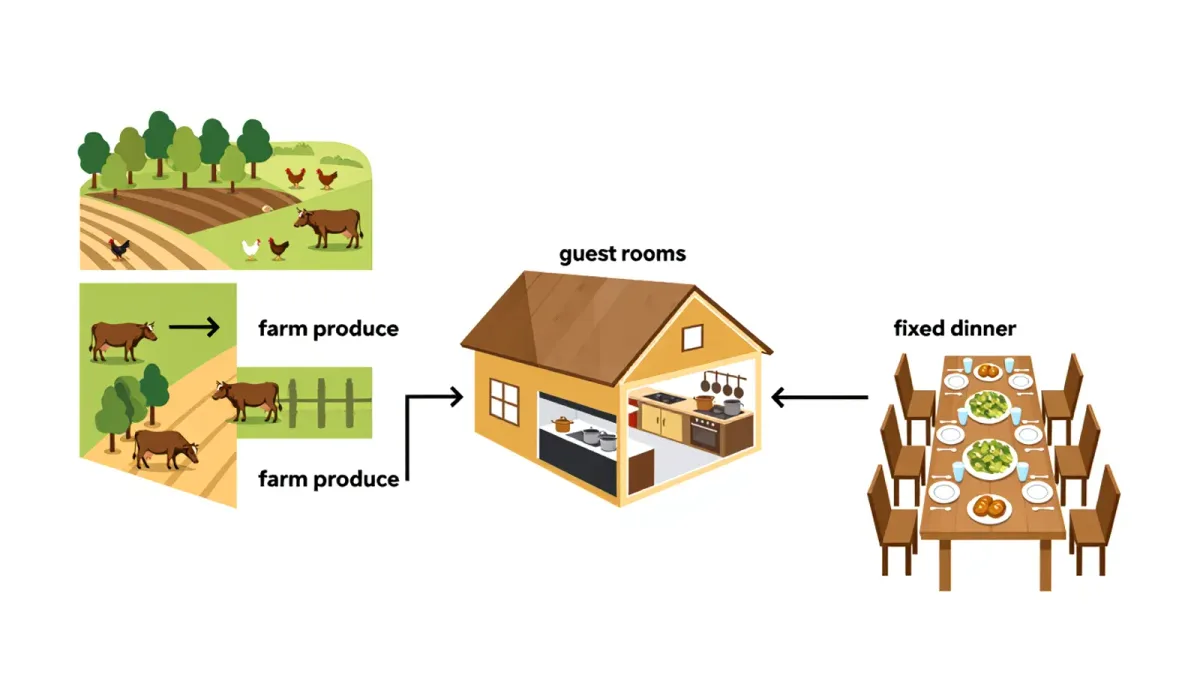
Italy counts roughly 25,000 farms that open their doors to paying guests, a sector created by the country's 1991 framework law on agritourism, per national agricultural statistics — and it remains the clearest working model of a hotel where the kitchen is the point. An agriturismo is a working farm that offers lodging and, in most cases, meals built from its own produce. The dinner is grown within sight of the table, the breakfast eggs were laid that morning, and the wine on the shelf was pressed in the building next door.
This guide explains how the farm-stay model works, what distinguishes a genuine agriturismo from a rural hotel with a vegetable patch, and how to choose one that will feed you well. It publishes information, not booking advice; verify every detail with the property before travel.
What makes an agriturismo different from a rural hotel?
The definition is agricultural, not decorative. Under Italy's framework law of 1991 and its regional successors, agritourism is a complement to farming: the accommodation and the meals must remain secondary to the farm's actual production, and what lands on the plate is supposed to come substantially from the farm itself or neighboring holdings. That legal shape — per the text of the legge quadro and regional implementing rules — is why an authentic agriturismo feels unlike a country hotel. The family are farmers first. Dinners are often at fixed times and communal; menus are short because the menu is the season; and nobody is plating anything for photography.
The model has spread well beyond Italy — France's fermes-auberges, Spain's casas de agroturismo in the Basque and Galician hills, and Portuguese montes all work on similar principles — but Italy's density and legal clarity keep it the reference market.
Where does the model work best for a food traveler?
- Tuscany and Umbria. The highest density in Italy, strong on olive oil, wine and pasta workshops; book well ahead for the summer season, and expect the farm-dinner formula — a fixed menu, a set hour, everyone at long tables.
- Puglia and Sicily. Masserie — fortified farmsteads — have restored at scale; the cooking leans on vegetables, legumes and olive oil, and winter stays show the quieter, truer rhythm.
- Piedmont. Fog-sensitive travelers come for Barolo and truffle country; fall stays coincide with the truffle fairs of Alba and the hazelnut harvest.
- Basque Country and Galicia. Agroturismo properties here often keep cider presses, cheese dairies or fishing links, and dinner frequently turns into an informal tasting of the farm's own output.
How do you judge the kitchen before you book?
Three questions separate the memorable from the merely rustic. First, does the farm actually produce what it cooks — ask which products are the property's own and which are bought in; a dairy farm serving its own cheese, or an olive estate pressing its own oil, is the genuine article. Second, is dinner a nightly event or on request only — at smaller operations the kitchen fires only with notice, sometimes only for guests who book a table a day ahead. Third, who cooks — many farm kitchens are run by the family's cooks, and several regions have built reputations on farmhouse tables that food writers have documented for decades, a history the slow-food movement in Piedmont helped put on record.
What does a stay cost, and when should you book?
Published rates in 2025 for Italian agritourism lodging commonly ranged from about €70 to €160 per night for a double room, with half-board — cena agrituristica, the fixed farm dinner — adding roughly €25 to €40 per person, per listings checked in 2025; apartments sleeping four or more shift the math toward self-catering, which misses the point of the kitchen. Harvest neighborhoods — Tuscany in September and October, Piedmont in October and November — fill months ahead, while the same farms in February take bookings a week out and feed you preserved tomatoes, cured pork and the year's oil, which is its own education.
Is half-board worth taking?
On a farm stay, yes, and it is not close. The farm dinner is the product — courses that follow whatever is ripe, the family's wine at table prices, no menu decisions to make after a day on the road. Travelers who book room-only routinely end up adding the dinner after the first night's smell reaches the courtyard.
The practical details
Confirm before booking: whether the kitchen serves non-guests (many do, by reservation); fixed dinner times; the farm's own products on the menu; driving distance from the nearest food-market town; and winter opening, since some properties close between November and March. All hours, prices and openings in this guide reflect farm listings current as of 2025 and should be reconfirmed directly, as farm-stay operations change season to season.