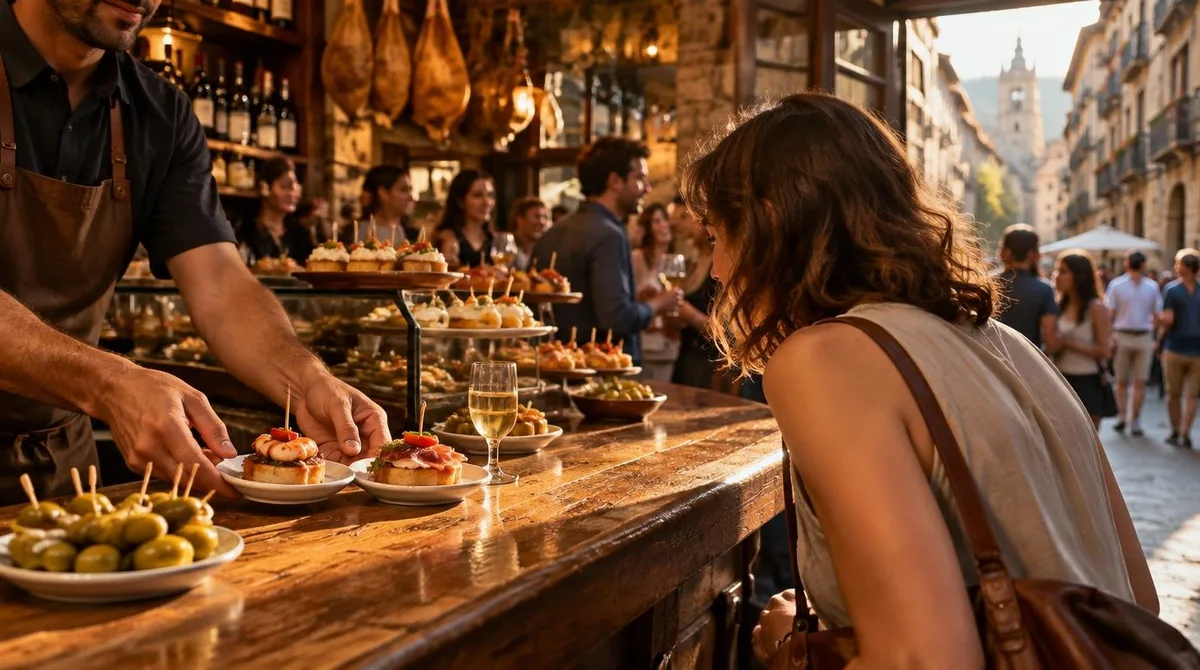
Pintxos give San Sebastián its itinerary. The city’s own tourism office frames going out for pintxos as an essential part of a visit to Donostia / San Sebastian, and the custom it describes is simple: move between several bars, taking one or two pintxos at each stop. The Basque regional tourism board goes further and calls the old quarter the temple of pintxos, its streets packed with visitors every weekend. The midday hour sets the pace, and the bars set the menu.
This page lays out the San Sebastian pintxos route without the guesswork: what counts as a pintxo, which bars hold documented signatures inside the Old Town, and when to time the walk. Neighboring food cities keep their rules in writing, and the pattern travels; Naples put its true-pizza rules in print, and travelers who plan around published formats eat better for it. The wider shelf of food-first guides holds the rest of the route.
What a Pintxo Is and How Ordering Works
The format is deliberately loose. The city’s tourism blog counts as many styles of pintxos as there are bars, and the menu is whatever the counter holds and the blackboard announces that day; the tourism office’s own advice is to let yourself be surprised by it. Prices are chalked beside the plates, an order is a pointed finger and a glass, and the household pour alongside it is txakoli or cider, exactly as the regional board describes the ritual. One bar, one or two bites, and the tab stays small. Then move on.
The Old Town Circuit: Documented Stops Within a Few Blocks
The bars below are chosen for signatures documented on the official pages of San Sebastián Turismoa and the Basque Government’s tourism service, listings current as of October 2026, and position inside the compact old quarter, which keeps the whole circuit on foot.
- Bar Tamboril (Pescadería 2): the office calls it a traditional pintxo bar with specialities such as pipa, its battered prawn, or the mushroom; the regional board points to the same bar for its mushrooms.
- Bar Ganbara (San Jerónimo 21): the regional board’s shorthand is a well-stocked bar in the heart of the Old Town.
- Goiz-Argi (Fermín Calbetón 4): listed by the regional board for its brochettes, the skewered signatures of the street.
- Txepetxa (Pescadería 5): the board’s stop for anchovies, two doors from Tamboril on the same lane.
- Bar Martínez (31 de Agosto 13): shellfish pintxos on the street the city’s blog records as the only survivor of the great fire of 1813.
- Casa Vergara (Nagusia 21): a bar the regional board describes as groaning with innovative pintxos; the city’s blog calls out its battered wedge of cod with pil-pil emulsion, opposite the Santa María del Coro Basilica.
Every address sits within a handful of blocks. The lane does the navigating. This connects to our earlier piece, Naples: The City Where Pizza Has a Rulebook.
Timing the Route: Midday Calm, Weekend Crowds
The regional board’s advice for the quarter is a midday stroll taken calmly, without following any particular route, washing down the pintxos with txakoli or cider. That is the relaxed window, and it repeats in miniature in the evening. The same board notes the streets pack every weekend, when the dozens of varieties on the counters draw the whole region into a few lanes. The one-or-two-pintxos rule is the pressure valve. It keeps an afternoon from tipping into a race.
Conclusion: Two Bites, Two Bars, No Guesswork
The route runs on published rails. Official tourism pages name the bars, the streets, and the signatures, from Tamboril’s prawns to Casa Vergara’s cod, and the ritual carries its own arithmetic: several stops, one or two pintxos each, txakoli in the glass. Go at the hour the board recommends and let the blackboard decide the rest. The bar does the thinking. For related coverage, see Cape Cod Day Trip: How to Plan a Perfect Day Trip to the Cape.