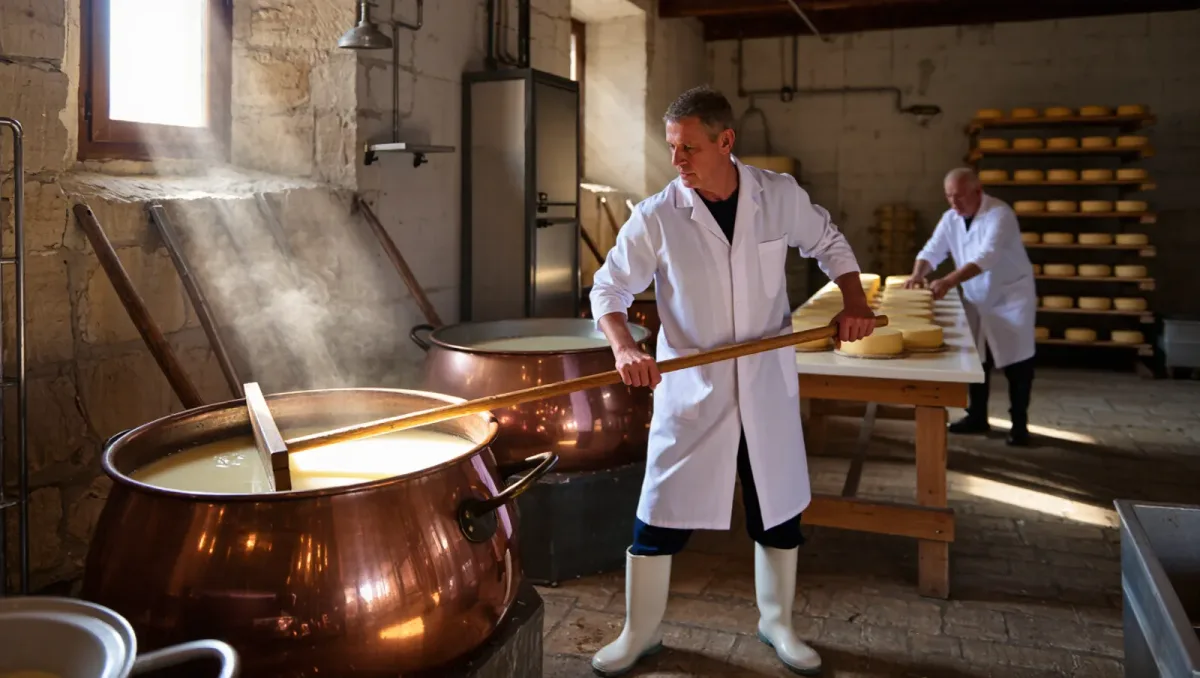
Comté, the gruyère-style wheel of France's Franche-Comté, is made under a Protected Designation of Origin that fixes everything a food traveler cares about: the milk must come from Montbéliarde and Simmental cows grazing the Jura plateau, it must be collected within hours and heated in copper cauldrons at small village dairies called fruitières, and the roughly 35-kilogram wheels — each the product of some 530 liters of milk — are then aged from four months to as long as three years in the cellars of a handful of professional aging houses.
This guide follows the cheese from cow to cellar to table: what a fruitière visit actually shows you, how the aging houses grade and sell their wheels, where the route's museums and saltworks sit, and what to pour beside it — because the Jura's strange, glorious vin jaune is the second half of the story. Details reflect current AOP-body and tourism sources as of early 2026.
What is a fruitière, and can you visit one?
A fruitière is the village cooperative dairy at the system's heart: member farms deliver morning and evening milk, and the cheesemaker — the fromager — works it in copper vats the same day. There are on the order of 160 production sites across the appellation, and dozens welcome visitors, typically at the morning make, which begins around 8 a.m. You watch the curd cut, gathered, and pressed into moulds, then taste at the sales counter with a stamp of the day's wheel numbers on the wall board. Visits are usually free or a few euros; Poligny, the cheese's capital town, and the villages of the Jura and Doubs valleys hold the densest cluster.
Watch for the milk grade on the wall: the system pays farmers on protein and bacteriology, a discipline the AOP's rules have enforced since the original appellation was granted in 1958. It is the quiet reason Comté tastes of grass and hay rather than salt and rubber.
How does aging work — and what do the labels mean?
Wheels leave the fruitières for the caves of the aging houses — the maisons du Comté — where cellar masters turn, brush, and salt them for months or years in cathedral-like vaults. Two of the houses run visits near Poligny and Arbois, and the sight is half the reason to come: tens of thousands of wheels in ranked rows, each stamped with its fruitière's number so provenance survives to the rind.
Before sale, each wheel is graded by a panel: those scoring highest earn the green "Comté Extra" band, mid-range wheels carry the standard label, and low scorers leave the appellation entirely. Age is a separate axis — four to eight months for mild, milky wheels; twelve to eighteen for crystalline, nutty ones; beyond twenty-four for the concentrated, brothy end — and good counters sell by both, so taste across ages rather than chasing the oldest wheel on the shelf.
Where does the route go?
The logical base is Poligny, seat of the appellation's professional bodies and home of the Maison du Comté visitor center, where the cheese's whole chain is explained in one building. From there, the loops are short: Salins-les-Bains and its royal saltworks — the evaporation works UNESCO inscribed in 2009 alongside Arc-et-Senans, the ideal royal saltworks up the valley — explain the salt without which no French cheese ages; Baume-les-Messieurs and the reculée valleys stage the plateau's drama; and Besançon, the regional capital with its Vauban citadel, makes a practical bookend.
Two other AOP cheeses share the ground: Morbier with its ash line, and Mont d'Or in its spruce box in season — winter through spring. Creameries and farm shops sell all three beside the Comté, and the cheese dairies' counters are the cheapest good lunch in the region.
What do you drink with Comté?
Vin jaune — the Savagnin wine aged for over six years under a veil of yeast in crown-capped bottles, bottled in the squat clavelin — is the Jura's answer, and its oxidative, walnut-and-curry character meets a twenty-month Comté with uncanny precision. Château-Chalon, L'Étoile, Arbois, and Côtes du Jura carry the appellation names; Arbois, the region's wine capital, pours them at every counter and hosts the producers' cooperative caves. The everyday pairing is equally local: a crémant du Jura or a chilled Savagnin ouillé, the non-oxidative style. Both cheese and wine travel well home — the wheel in vacuum, the clavelin in a packed case — and the mechanics of getting them there intact are covered in our guide to packing gourmet souvenirs.
When should you visit?
The route works from April to October, when every fruitière runs its full visit schedule; spring adds the transhumance festivals in May, when the herds climb to summer pasture with bells and banners, and autumn adds the vin jaune gatherings, notably the Percée du Vin Jaune each early February in a rotating village — a winter festival that books the region's rooms a year ahead. Winter visits are quiet and beautiful but check hours: village dairies keep farmer schedules, not tourist ones.
How do you taste across a cheese that has a hundred faces?
The appellation's own tasting lexicon is the traveler's best tool: professional graders describe Comté in terms of fruit, toasted nuts, roasted hazelnut, butter, cream, chocolate, and plant notes, and a good counter will line up three ages so those words become visible. Ask for a young, a middle, and a long wheel; taste from mild to old; and let the long one sit a minute on the palate — the crystalline crunch comes from tyrosine clusters that form only in wheels past their first year. Breakfast at the region's market cafes does the same lesson cheaply: a wedge of fourteen-month Comté on nut bread with a cup of Arbois coffee is the plateau's own morning.
Frequently asked questions
Is Comté the same as Gruyère? They are cousins, not twins: French Comté is its own protected appellation with raw milk, village cooperative production, and grading, while Swiss Gruyère follows a separate specification. The textures rhyme; the milk and the cellars differ.
Can travelers buy wheels directly? Yes — fruitières and aging houses sell wedges and half-wheels at the counter, and vacuum packing for travel is standard. Airport rules for dairy in your own luggage depend on your destination's customs rules, so check before you buy the half-wheel.
How long is a visit? A morning make at a fruitière takes 45–60 minutes; an aging-house tour runs about an hour and should be reserved in advance, especially in July and August.
Is it worth going beyond Poligny? Yes — the Salins saltworks and the Baume-les-Messieurs valley are within a half hour, and the vin jaune villages around Arbois are a 20-minute drive east.