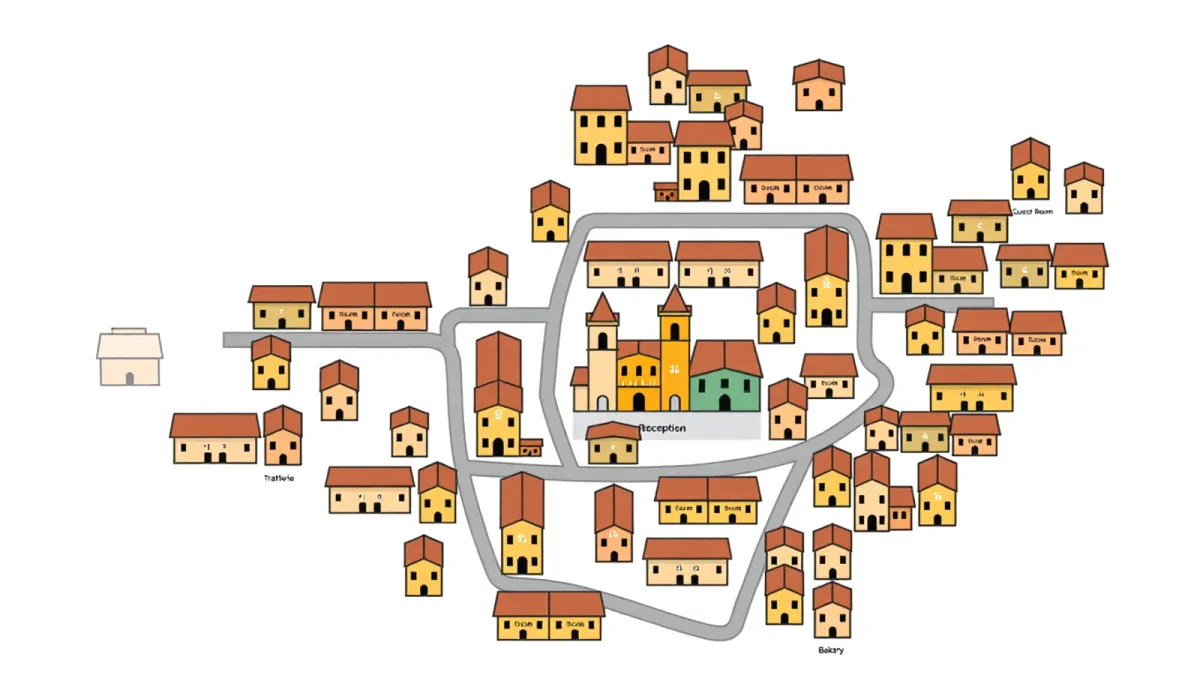
The albergo diffuso — the scattered hotel — was formalized in Italy in the early 2000s by tourism researcher Giancarlo Dall'Ara, working from the problem of historic villages emptied by depopulation and, before that, by the 1976 Friuli earthquake, per the model's documented history in Italian tourism studies. Rooms in a historic center are restored and run as one hotel under one reception, but the bedrooms stay where the village's old houses stand. For a food traveler the consequence is structural: there is no hotel restaurant to hide in. Breakfast comes from the village's bakery, dinner from its trattoria, and the town's remaining residents are the concierge's address book.
This guide explains how the albergo diffuso model works, where the strongest examples are, and why it is arguably the most food-immersive hotel format in Europe. It publishes information, not booking advice.
How does an albergo diffuso work?
One hotel, many buildings. A single operator restores a cluster of historic rooms — often medieval or 18th-century houses in a protected borgo — and runs them with shared services: one reception, breakfast service, housekeeping, a common salon. The defining rules, per the quality criteria Dall'Ara's framework established and the albergo diffuso associations that promote the format: the buildings must be original, the village must be lived-in rather than a stage set, and the hotel must source services locally. The guest checks in at a desk in the piazza and sleeps three alleys away.
Why does the format suit food travelers so well?
Because it removes the hotel's walls from the experience. In a conventional hotel, the property competes with the destination for the guest's meals; in a scattered hotel, it cannot. Breakfast arrives at a village café or a restored kitchen with local bread, cheeses and preserves from the surrounding hills. The operator's real value is introductions: which family still makes pecorino in the valley, which trattoria is open in November, where the cantina pours by the glass. Several scattered hotels organize dinners in private homes or in the village's osteria as part of the stay — a format documented across the best-known borghi projects, per their own guest materials.
Where are the strongest examples?
- Abruzzo. Santo Stefano di Sessanio, a medieval wool-trading village in the Gran Sasso, holds the format's most famous project — rooms scattered through restored houses, with the lentils of Santo Stefano, a protected local variety, anchoring the food identity.
- Sardinia. Interior hill towns such as Nughedu Santa Vittoria and Lodine run scattered projects where shepherding culture — cheeses, roast suckling pig, pane carasau — is the cuisine.
- Friuli. The region where the model began after the 1976 earthquake; restored borghi here pair with one of Italy's great white-wine territories.
- Beyond Italy. Adaptations exist across Spain's emptied villages and in France and Greece, though Italy's formalized criteria and network remain the reference, per the model's promotion by Italian tourism bodies.
What does a stay cost, and how do you book?
Published rates in 2025 for scattered-hotel rooms commonly ran from about €80 to €180 per night depending on region and season — comparable to quality rural hotels and below the resort tier, per listing checks in 2025. Booking is direct more often than not: many alberghi diffusi are small operations with their own sites and email, and the pre-arrival exchange is where a food traveler earns the value — asking for the week's village food calendar, the bakery's days, the trattoria to book. Car-free access is difficult; these are hill villages, and a car remains the practical default.
What are the trade-offs?
Honest ones. Service is lighter than a resort's — no room service at midnight, sometimes no staff on site overnight. Rooms in protected buildings mean idiosyncratic layouts, occasional thin insulation, and stairs. Villages are quiet in the evening by the nature of their demographics, and some收缩 in winter, with a subset of restaurants open only on weekends. The compensation is proportionate: a medieval house to yourself, a village that knows your name by day two, and dinners that no hotel kitchen could replicate.
The practical details
Confirm before booking: reception hours and late-arrival arrangements; breakfast location; winter and midweek openings of village restaurants; parking — hill borghi often restrict cars to lots outside the walls; and whether the operator arranges food experiences, from tastings to home dinners. All details here reflect scattered-hotel materials current as of 2025; the format is small-scale and changes property by property, so reconfirm directly.