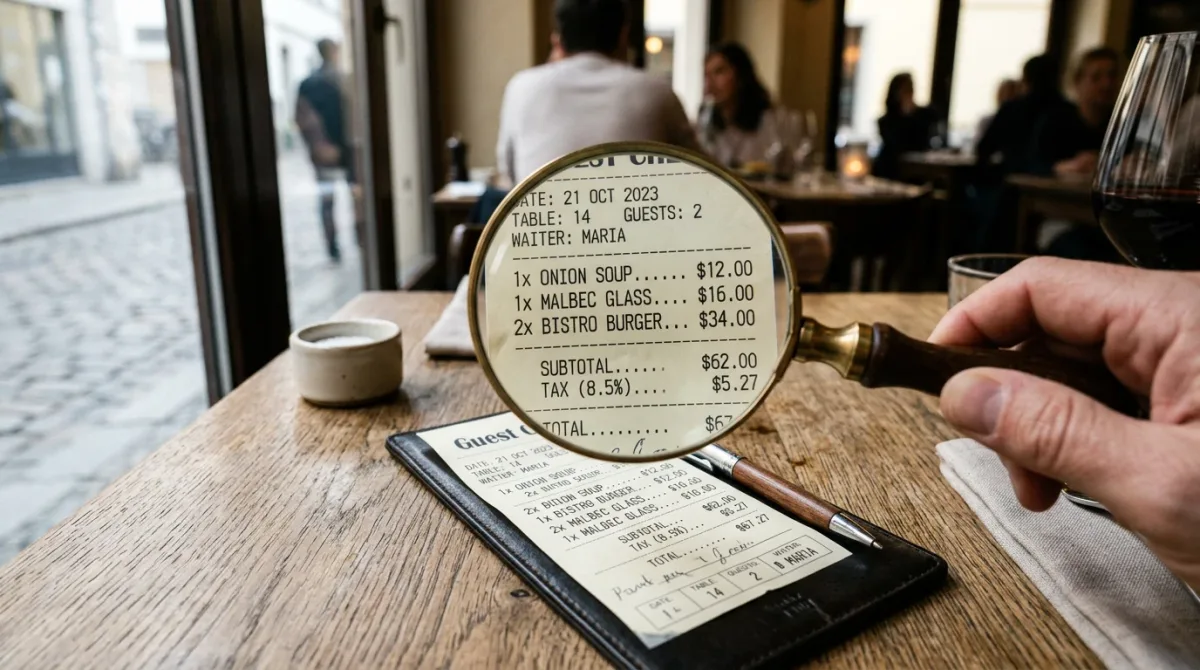
Since April 19, 2026, New York City restaurants have operated under a new city rule spelling out what counts as a legitimate surcharge on a check, per the NYC Department of Consumer and Worker Protection's adopted rule. Layered on top of a 2024 state law capping credit-card fees, the two rules together set the boundaries for the extra lines diners increasingly find above the tip on a Manhattan bill.
The city rule, filed by DCWP and published through the Rules of the City of New York, was built to settle a fight that had been simmering since the pandemic-era rise of blanket "kitchen appreciation" or administrative fees: which added charges are legitimate business costs passed to the customer, and which are just disguised menu markups. The rule's core move is defining what DCWP calls a "bona fide" service charge — one tied to an actual extra service, such as splitting a dish, a per-person minimum, or a mandatory gratuity for large parties — as opposed to a flat surcharge tacked onto every check regardless of what happened at the table.
Under the adopted rule, a restaurant can still charge a mandatory gratuity, but only when the proceeds go to the restaurant's own staff under a written agreement — the rule's language points specifically to something like a collective bargaining agreement covering tip-eligible workers. Whatever the charge, the rule requires it be "conspicuously disclosed to the consumer" before food or drink is ordered, which DCWP's filing extends across menus, digital ordering platforms, and any interface a guest uses to place an order — not just fine print on a paper check that arrives after the meal.
DCWP's filing is explicit that the rule doesn't touch labor law: restaurants covered by the surcharge rule still have to comply with New York's separate wage-and-gratuity statutes, meaning a mandatory charge labeled a tip has to actually function as one under state law, not just in the restaurant's own paperwork. The same filing shows the rule wasn't rushed through — DCWP logged public comment on the proposal through a hearing that closed December 10, 2025, four months before the rule took effect, with restaurant operators and consumer advocates weighing in on where the line between a real service and a padded fee should sit.
That city rule sits on top of a broader state law that's been active since February 11, 2024. New York's credit-card surcharge law, signed by Governor Kathy Hochul, requires any business — restaurants included — that adds a fee for paying by credit card to either post the full card price up front or show a two-tier menu with separate cash and credit prices, so a diner sees the real total before ordering rather than discovering it at settlement. The law caps that specific surcharge at whatever the business itself is charged by the card processor — no markup on top of the swipe fee — and it doesn't apply to debit cards at all. "New Yorkers should never have to deal with hidden credit card costs, and this law will ensure individuals can trust that their purchases will not result in surprise surcharges," Hochul said when the law took effect. Then-Secretary of State Walter Rodriguez, whose Division of Consumer Protection built the compliance guidance, put the standard for consumers plainly: a right to know the total cost of the purchase, including any surcharge, before reaching the register.
The two rules answer different questions on the same check. The state law governs the specific case of a card-processing surcharge and how it has to be shown before you pay. The city rule governs everything else that isn't the menu price of the food itself — service charges, mandatory gratuities, per-person or large-party add-ons — and requires the restaurant to show its work on what the charge is for and where the money goes. A diner who spots an unfamiliar percentage above the subtotal can ask two questions to sort it out: is this a card fee, capped at the processor's own rate and disclosed before ordering under the 2024 state law, or is it a service charge, which now has to be tied to an actual bona-fide service and disclosed just as early under the city's rule that took effect this spring.
Complaints about either kind of charge go to different desks. Credit-card surcharge violations can be reported to the state's Division of Consumer Protection, the state Attorney General, or local consumer affairs offices, according to the governor's office. Service-charge and gratuity questions specific to a New York City restaurant fall to DCWP, the agency that wrote and adopted the surcharge rule that took effect in April.
For restaurants still running blanket administrative fees dating back to 2021 or 2022 menu redesigns, the city rule is the one worth rereading first. DCWP's own hearing record flagged exactly the kind of ambiguity the final rule tries to close: what counts as a party large enough to justify a mandatory charge, and how clearly that charge has to be spelled out before a guest ever sees a menu. Neither rule requires a restaurant to drop service charges or credit-card fees altogether — both are still legal tools for covering real costs. What changed is the burden of proof: a flat percentage added to every table's check now has to trace back to either a capped, disclosed card-processing cost under the 2024 state law, or a specific, disclosed service under the city's 2026 rule, rather than functioning as an undisclosed add-on to the menu price itself.
Diners who want to check a specific restaurant's practice before sitting down have a straightforward test drawn from both rules: does the posted menu, website, or ordering app show the extra charge and what it's for before an order goes in, and does the printed or emailed receipt spell out the same charge again. If either answer is no, that's the gap both the state and city rules were written to close, and it's the detail worth raising with the restaurant, or with DCWP, before assuming a mystery line on a Manhattan check is just the cost of doing business in the city now.
For a related restaurant news perspective, read How a Manhattan restaurant actually gets permission to put tables on the sidewalk.
For more context, read How Restaurant Reservation Deposits and No-Show Fees Work.
For more context, read The letter grade in every NYC restaurant window, explained.
For more context, read How a restaurant actually earns its A in New York City.