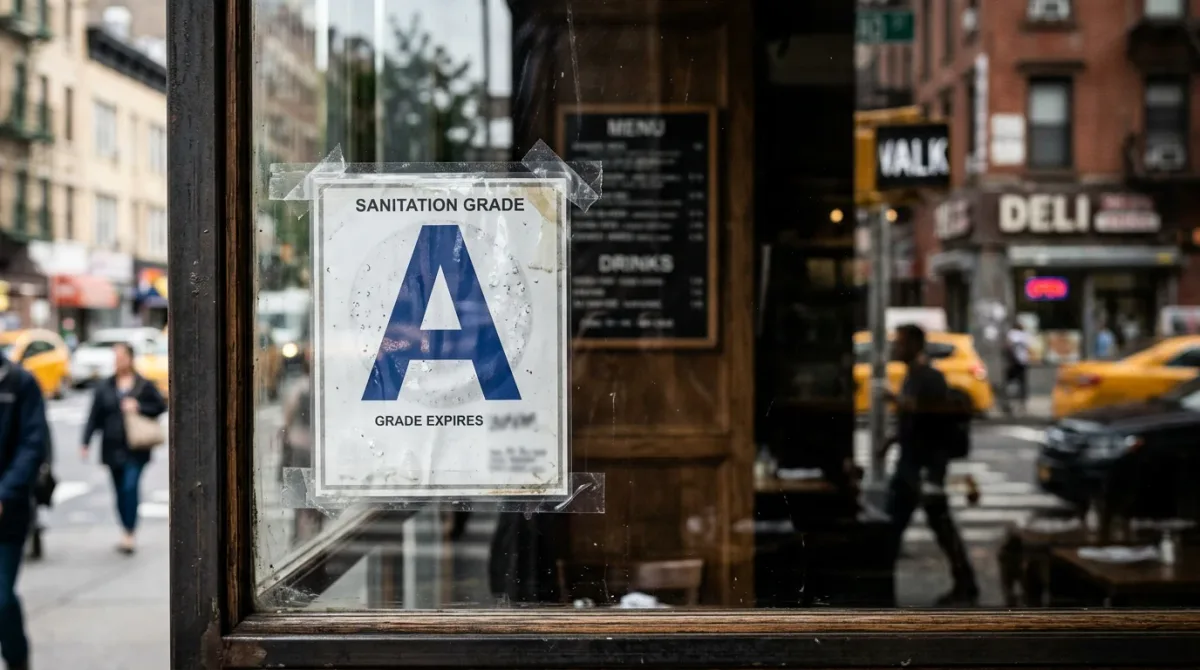
Every restaurant in New York City is required to post a letter grade near its entrance, and almost nobody eating under it knows how the number behind it got made. The grade — A, B, or C — comes from a points score the city’s Health Department assigns after an unannounced inspection, and it can flip with the next visit, per the department’s own program page.
The system covers roughly 29,000 food establishments citywide, tracked through a public lookup tool called ABCEats, according to the Health Department’s restaurant grading page. That is the baseline fact worth knowing before any of the specifics: the grade in a Manhattan diner’s window and the grade in an outer-borough steakhouse’s window are generated by the identical scoring mechanism, applied by the same agency, on the same schedule.
What do A, B, and C actually mean?
The letters map directly to a numeric score, and the math runs backward from what most diners assume: a lower score is a better grade. According to the department’s scoring guide, a restaurant lands an A with a score between 0 and 13 points. A score of 14 to 27 points earns a B. Anything 28 points or higher is a C. Every violation an inspector logs adds points toward that total — there is no separate “deduct for good service” column and no credit for ambiance.
How is a score actually built?
Inspectors evaluate five areas on every visit: food handling, food temperature, personal hygiene, facility and equipment maintenance, and vermin control. Violations are sorted by how serious they are, and each tier carries a point floor before extras are added. A public health hazard starts at a minimum of 7 points. A critical violation starts at a minimum of 5. A general violation starts at a minimum of 2. On top of that floor, the department assigns a “condition level” from 1 to 5 depending on how extensive the problem is — a single mouse dropping and an active infestation are the same violation category but very different point totals.
The Health Department conducts these inspections at least once a year, unannounced, which is why a restaurant cannot simply clean up for a scheduled visit the way it might for, say, an expected supplier delivery. A kitchen that has been running clean all year and a kitchen that scrambled the morning of are, for scoring purposes, judged on exactly the same five categories with exactly the same point values.
The condition-level system is what lets two restaurants land in the same violation category with very different point totals. A single lapse gets logged near the bottom of that 1-to-5 range; a pattern — the same problem found repeatedly, or spread across the kitchen — gets logged near the top. Two restaurants can both be cited for, say, improper food temperature and still walk away with very different point counts depending on how extensive the inspector found the problem to be.
What happens after a restaurant scores a B or C?
A first inspection that scores at B or C level does not go up in the window right away. Instead it stays ungraded and triggers a second, unannounced re-inspection roughly a month later. A restaurant effectively gets two chances per cycle to land an A. If that re-inspection also comes back at 14 points or higher, the letter grade that gets posted — B or C — is the one that shows, and the restaurant is issued what the department calls a grade-pending card while it awaits a hearing at the Office of Administrative Trials and Hearings, per the scoring guide.
Only initial A scores, and whatever grade comes out of the re-inspection, become the official letter posted to the public. A messy first inspection that gets fixed and re-scored as an A is not held against the restaurant going forward — the current card is what is on file, not the history.
What if the card in the window gets lost or damaged?
This is more common than it sounds, especially in older storefronts where a taped card near a door takes weather and foot traffic. The Health Department’s guidance for operators notes that a restaurant can get a replacement letter-grade card through the department’s Customer Service Office rather than waiting for the next scheduled inspection. New restaurants also have a separate on-ramp: the department offers consultative inspections aimed specifically at food establishments that have not opened yet, intended to catch problems before the clock on official grading even starts.
Where can a diner actually check before sitting down?
The card by the door is the fastest signal, but it is a snapshot from whenever the last inspection landed, not necessarily this week. The full, searchable record for any address lives in ABCEats, the department’s public lookup tool, which covers the same roughly 29,000 establishments the grading program tracks. It is the more complete version of the same information the window card is summarizing in one letter.
Does an A mean the food is actually good?
No, and the department’s own materials do not claim otherwise. The five categories an inspector scores — food handling, food temperature, personal hygiene, facility and equipment maintenance, and vermin control — are food-safety categories, not taste categories. A restaurant can hold an A while serving a menu a critic would pan, and a restaurant can lose points to a facility issue with nothing to do with what lands on the plate. The grade is a compliance snapshot, not a review, and it was built and is administered by a public-health agency rather than anyone tasting the food.
None of this tells a diner whether the room is worth the wait or whether the kitchen has a point of view — a grading system built around food-safety violations was never designed to answer those questions. What it does answer, reliably, is the one thing a letter in a window claims to answer: how the place scored on the specific, unannounced day someone from the city walked in and started counting.
For a related restaurant news perspective, read How a Manhattan restaurant actually gets permission to put tables on the sidewalk.
For more context, read How a restaurant actually earns its A in New York City.
For more context, read How Restaurant Reservation Deposits and No-Show Fees Work.