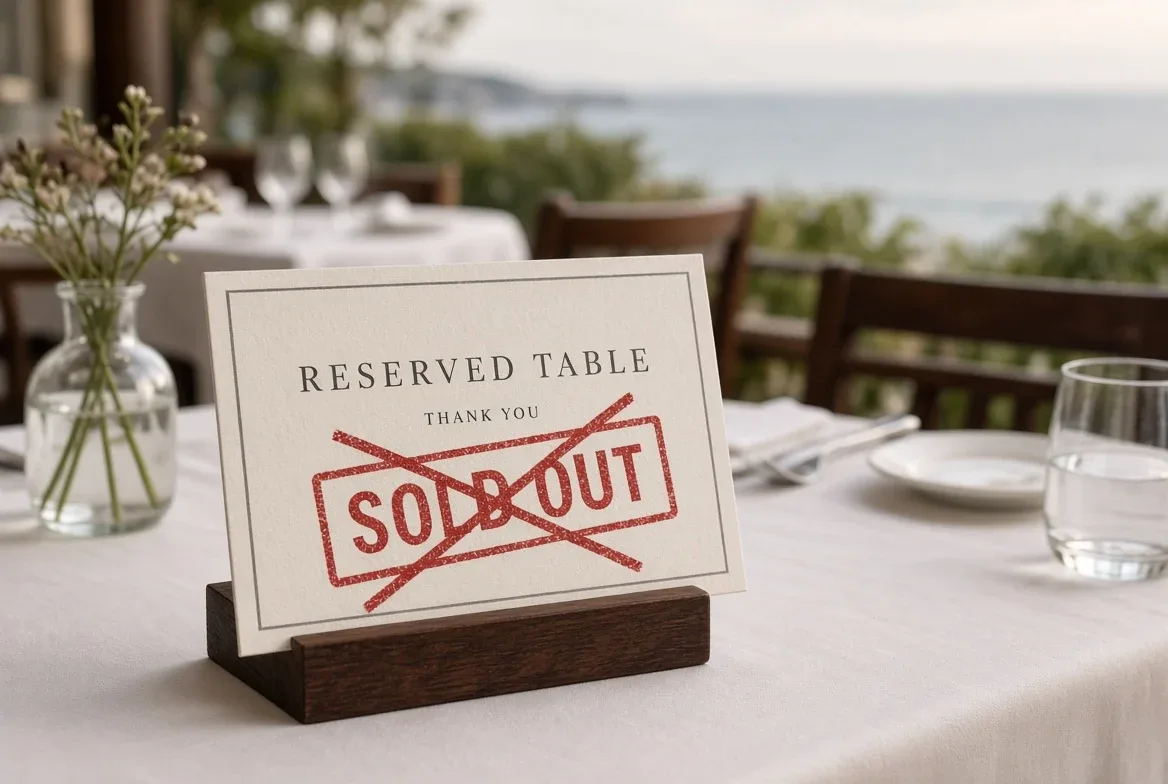
If a website is offering you a "guaranteed" table at a fully booked restaurant for a fee on top of the bill, that's reservation scalping, not a booking service — and it's now illegal in a growing list of places. New Jersey became the latest state to ban it when Gov. Mikie Sherrill signed a bill into law on May 7, 2026, following Florida and New York. For travelers chasing a table at a famous restaurant, the safest move is still booking direct.
Reservation scalping works like ticket scalping: a third-party service uses automated tools or mass bookings to lock up hard-to-get tables the moment they open, then resells access to them, often for a markup or a commission, without the restaurant's permission. One of the platforms named in state investigations, Appointment Trader, has been described as taking a 20-30% commission on resold reservations, according to reporting on Florida's law.
Which states have actually banned it
New York passed the first state law targeting the practice, and Florida followed with its own Restaurant Reservation Anti-Piracy Act, signed by Gov. Ron DeSantis and effective July 1, 2025, according to reporting on the Florida law. Philadelphia added a city-level version that took effect in April 2026, with civil fines up to $1,000 per violation, according to the same reporting chain. New Jersey's law, formally A3318/SCS for S1193 and S1197, was signed by Gov. Sherrill on May 7, 2026, according to the New Jersey Governor's Office. It prohibits third-party services from advertising, listing, or selling restaurant reservations without a written agreement with the restaurant.
| State or city | Status | Effective |
|---|---|---|
| New York | Enacted (first state to act) | Not specified in available reporting |
| Florida | Restaurant Reservation Anti-Piracy Act, signed | July 1, 2025 |
| Philadelphia | City ordinance | April 2026 |
| New Jersey | A3318/SCS for S1193 and S1197, signed | May 7, 2026 |
New Jersey's push had a specific trigger: state Sen. Kristin Corrado said lawmakers were "taking action to prevent reservation scalping before the World Cup," a nod to the 2026 tournament bringing matches and crowds to the New York-New Jersey region this summer. Gov. Sherrill said the practice "harms restaurants' relationships with customers, while driving up costs to dine out."
What the laws actually target
None of these laws go after diners for booking through OpenTable, Resy, or Tock — the restaurants' own reservation systems. They target unauthorized third parties that scoop up reservations they have no arrangement to hold and resell them for profit. New Jersey's law caps civil penalties at $500 per violation, accruing daily per restaurant, and lets restaurants and diners seek damages in Superior Court, according to reporting on the law. Florida's version is steeper: violators face fines of $1,000 per day, per reservation, per restaurant. Philadelphia's ordinance is narrower still — it doesn't stop an individual from privately reselling their own reservation, only commercial resale services operating without the restaurant's consent, according to a National Restaurant Association spokesperson quoted in that coverage.
Why restaurants pushed for this
The complaint from restaurants isn't really about the markup — it's about no-shows. When a scalping platform books a table it doesn't actually hold a real relationship with the diner over, the restaurant can end up with an empty slot that never gets filled the way a normal reservation would, according to reporting on New Jersey's law. That's part of why the pushback has industry backing, not just lawmakers behind it: Resy and Tock's own chief executive, Pablo Rivero, publicly endorsed Florida's law, calling it "a critical step in stopping the exploitative practices that hurt these small businesses and their customers," according to reporting on the Florida law.
Who's actually affected by this
This mostly matters if you're chasing one of a small number of restaurants famous enough to sell out in seconds — the kind of place that makes headlines for impossible reservations. For most trip planning, it's a non-issue. But if you're the type of traveler building a trip around one specific table this year, especially in New York, New Jersey, Florida, or Philadelphia, it's worth knowing the difference between a legitimate booking site and a scalping site before you pay anyone a markup for a "guaranteed" slot.
How to avoid getting scalped
Book directly through the restaurant's own website or its listed reservation platform — OpenTable, Resy, and Tock are the platforms named as legitimate booking channels in this reporting, and none of the new laws restrict how they operate. Treat any third-party site charging a fee to "guarantee" a specific time slot as a red flag, especially if it isn't one you recognize as the restaurant's own listed partner. Florida Restaurant & Lodging Association president Carol Dover put the underlying problem plainly in comments on the state's law: unauthorized resale platforms "inflate costs, damage reputations, and leave restaurants with empty tables" when resold bookings go unused. If a listing looks too easy for a famously hard reservation, that ease is usually the tell — and with four jurisdictions now writing fines into law over it, resale sites have more to lose by getting caught than they used to.
For a related guides perspective, read Whether your Amsterdam Schiphol layover is long enough to leave the airport.
For more context, read How Restaurant Reservation Deposits and No-Show Fees Work.
For more context, read How a restaurant actually earns its A in New York City.
For more context, read The letter grade in every NYC restaurant window, explained.