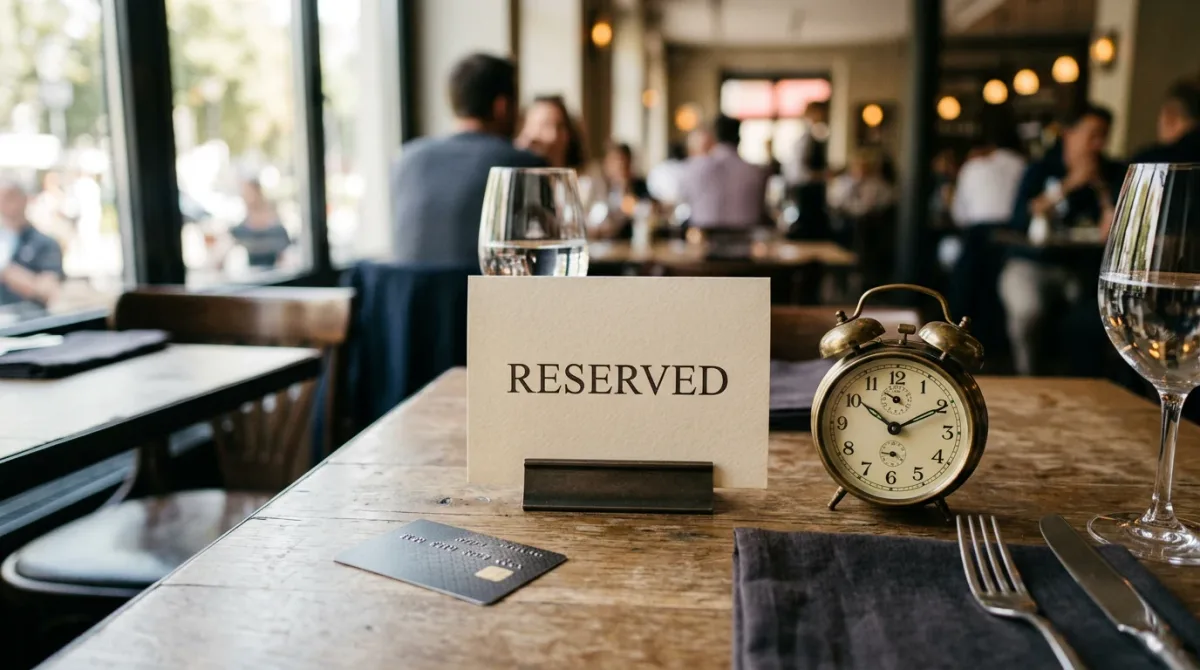
Fine-dining restaurants in major cities increasingly require a credit card at booking and can charge diners $25 to $50 a head for missing a reservation without adequate notice, according to reservation platform OpenTable and restaurant-industry reporting — a shift city-break travelers should plan around before booking a table in an unfamiliar city.
The practice is not universal, and it is not new, but it has spread well beyond the small circle of ultra-exclusive tasting-menu rooms where it started. For a traveler booking three or four dinners in a city they do not live in, understanding how deposits, credit-card holds, and cancellation windows actually work — and how they differ from restaurant to restaurant — is now as practical a piece of trip planning as knowing a hotel's check-in time.
Why More Restaurants Now Charge to Reserve a Table
The shift is a direct response to no-shows. In an April 2021 survey commissioned by OpenTable, 28 percent of Americans said they had failed to show up for a restaurant reservation they had made in the previous year. OpenTable's own reporting on the problem cited Philadelphia restaurant Blackfish, where six no-shows in a single week wiped out roughly 5 percent of revenue — by the restaurant's account, most of its profit margin for that stretch of service, once the food bought and staff scheduled for those tables is counted as a sunk cost.
By 2024, that math had pushed reservation deposits into more mainstream dining rooms, not just the hardest-to-book tasting counters. CBS News reported that some fine-dining restaurants were charging $25 to $50 per person at the time of booking, citing Manhattan restaurant Torrisi as an example at the higher end of that range, with the deposit applied to the final bill if the diner shows up. Brian Warrener, who teaches at Johnson & Wales University's College of Hospitality Management, told CBS News the fees "give diners some skin in the game and serve as powerful motivation to show up" — the same logic, he noted, behind requiring payment up front for concert tickets or hotel rooms.
How Cancellation Windows and Card Holds Actually Work
The mechanics vary by platform and by restaurant, and reading them before booking is the only way to know what a traveler is agreeing to. OpenTable's terms and conditions, last updated July 22, 2026, spell out the baseline: the platform "may place a temporary authorization" on a diner's card "to confirm that the debit or credit card information you have provided is accurate," a hold that is typically released "within a few days" once verified. Separately, OpenTable's terms require that "users must cancel any reservations that they will be unable to honor at least 30 minutes in advance of the reservation," either through the app or by calling the restaurant directly.
That 30-minute window is only OpenTable's own floor. Individual restaurants set their own, tighter cancellation policies — commonly 24 to 72 hours' notice for tables that require a deposit — and OpenTable's terms state plainly that those restaurant-specific rules govern: a diner "may be required to cancel your reservation in accordance with the Restaurant's cancellation policy, which is disclosed at the time the reservation is made," and OpenTable disclaims any liability for charges resulting from a diner missing that window. In practice, the restaurant's policy, not the platform's, is what determines whether a deposit is refunded, forfeited, or applied to the bill.
What This Means for a City-Break Itinerary
None of this is unique to any one city, which is precisely why it matters for travelers moving between them. A cancellation window that is generous in one restaurant's booking flow can be strict in the next, and a deposit that reads as fully refundable can convert to a flat no-show fee the moment a traveler's flight is delayed or a museum visit runs long. Because the terms are disclosed at booking rather than standardized across a destination, the safest approach is to treat every reservation confirmation email as a document worth rereading, not a formality.
Restaurants that require a deposit or a card on file typically disclose it clearly during the booking flow, and confirmation emails usually restate the cancellation deadline and any fee amount. Travelers booking several dinners for one trip should note each restaurant's specific cutoff separately rather than assuming they match, since — as OpenTable's own terms make clear — the platform's minimum notice period is frequently shorter than what an individual restaurant actually requires.
How to Avoid an Unexpected Charge
- Read the cancellation window at booking, not after. The deadline is disclosed in the reservation flow and restated in the confirmation email; note the exact date and time, not just "a day or two before."
- Cancel or modify through the same platform used to book. A phone call to the restaurant is usually accepted as an alternative under OpenTable's terms, but doing it through the app or site creates a timestamped record.
- Build in a buffer for travel delays. Because deposits are commonly tied to windows of 24 hours or more before the meal, a same-day flight delay can already be inside the no-show window by the time it happens.
- Expect the deposit to apply to the bill, not stack on top of it, if the reservation is honored. Reporting on fine-dining deposits describes them as credited toward the final check rather than charged in addition to it.
Frequently Asked Questions
Is a reservation deposit the same as a no-show fee? Not exactly. A deposit is collected or authorized at booking and is typically applied to the bill if the diner arrives; a no-show fee is what is charged, sometimes from that same authorized amount, if the diner does not cancel in time and never shows.
How much notice do restaurants usually require to cancel without a fee? There is no single industry standard. OpenTable's platform-wide terms set a 30-minute minimum, but individual restaurants set their own, often longer windows, disclosed at the time of booking.
Does the deposit get refunded if I cancel in time? Under OpenTable's terms, that depends on the individual restaurant's stated cancellation policy rather than a platform-wide rule, since the restaurant's policy is what governs the charge.
Why are restaurants doing this now instead of just raising menu prices? Industry sourcing points to no-show rates — OpenTable-commissioned survey data put the share of Americans who had skipped a booked reservation at 28 percent — as the direct driver, with deposits framed as a way to protect margin on the specific tables affected rather than raising costs for every diner.
For a related hotels perspective, read US Hotel Bookings Must Now Show the Full Price Upfront, Resort Fees Included.
For more context, read The letter grade in every NYC restaurant window, explained.
For more context, read How a restaurant actually earns its A in New York City.