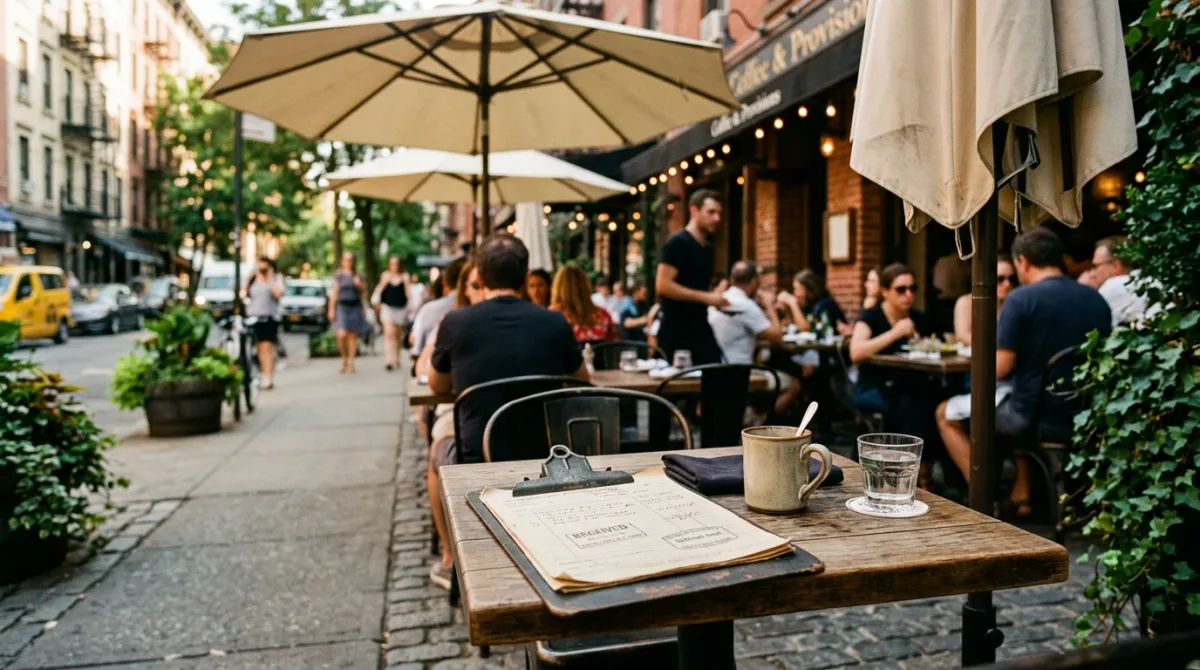
Every sidewalk café and roadway dining shed a diner sits at in Manhattan today operates under Dining Out NYC, the city's permanent outdoor dining program run by the Department of Transportation, and the DOT's own guidance tells restaurants to budget up to six months for review. Sidewalk setups can run year-round once licensed; roadway setups are seasonal, permitted only from April 1 through November 29.
What does a restaurant actually need to qualify?
Two baseline rules decide eligibility before a restaurant fills out a single form, according to the program's official eligibility and feasibility guidance: the space has to be on the ground floor, visible from the street, and reachable directly from it, and the operator has to hold a food service permit from the Department of Health and Mental Hygiene. From there, sidewalk applications can be filed anytime; year-round roadway licenses, per the same guidance, were set to open for new applications in early September 2026.
Location rules narrow the field further. A roadway café can't sit in a No Standing Zone, a bus stop, or a bus lane. A sidewalk café can't spill into the curbside "furnishing zone" — the strip reserved for street trees, signage, and utilities — or block the pedestrian clear path, both restrictions the program's eligibility page spells out for anyone site-planning a setup before they apply.
Why does approval take so long?
A full license isn't just a DOT sign-off. It also requires a community board review and a public hearing before DOT issues final approval, which is why the agency quotes review timelines of up to six months for sidewalk licenses and up to five months for roadway licenses. In a February 2025 update on the program, DOT said restaurants had filed roughly 3,800 applications from more than 3,000 restaurants citywide — about 2,300 for sidewalk cafés and 1,400 for roadway dining — and that close to 3,000 sidewalk and roadway setups were already permitted to operate, a program the agency described as 2.5 times the size of the pre-pandemic sidewalk café program, according to the DOT press release. To keep restaurants running while paperwork moved, DOT began granting conditional approvals to applicants who had completed their public hearing, letting them open for the season without waiting on the full file to clear. "Outdoor dining on our sidewalks and roadways has been a lifeline for many restaurants, and we are cutting through red tape to ensure that thousands of restaurants will be up and running as the weather warms," DOT Commissioner Ydanis Rodriguez said in that release.
What's different between a sidewalk café and a roadway café?
The split isn't just paperwork — it's the calendar and the geometry. Sidewalk cafés, set up on the existing sidewalk, are licensed for year-round use. Roadway cafés, built out into a parking lane, are licensed only for the April-to-November season and have to come down for winter. The design and siting rules governing both — clearances, structure materials, how close a setup can sit to an intersection or a street tree — come from a DOT rule the city adopted with an effective date of March 3, 2024, replacing the improvised sheds of the emergency Open Restaurants era with a single set of standards, per the adopted rule record.
What happens if a restaurant skips the process?
DOT set a hard deadline of August 3, 2024, for restaurants still running temporary pandemic-era setups to either convert to a Dining Out NYC license or remove their structure, with compliance due within 30 days of approval or by November 1, 2024, whichever came first. An operator that sets up without a license risks fines the agency lists at $500 for a first offense and $1,000 for each one after that. "Don't delay, apply today!" Rodriguez said when the agency pushed that deadline, while then-Small Business Services Commissioner Kevin D. Kim framed the program's ambitions more broadly: "Move over, Paris — New York is the global destination for outdoor dining!"
Once a restaurant is approved, what can it actually build?
Getting the license doesn't mean improvising with whatever plywood and umbrellas were left over from the pandemic. DOT paired the new rules with a Dining Out Marketplace, a portal the agency launched in May 2024 to connect approved restaurants with vendors selling prototype tables, planters, and enclosure designs built to the program's size and materials standards, according to the same DOT release announcing the August 2024 conversion deadline. The idea, DOT said at the time, was to make compliant setups affordable and easy to source rather than leaving each restaurant to design and defend its own structure to a community board. Restaurants that need help navigating either the license application or the marketplace can call the Department of Small Business Services hotline, which DOT lists alongside the application portal in its own guidance.
How did the city get from folding tables to a licensing system?
Dining Out NYC is the deliberately slower, permanent successor to Open Restaurants, the emergency program that let restaurants build outdoor seating with minimal review during the pandemic. The city spent 2023 drafting rules for a year-round sidewalk season and an eight-month roadway season, holding a public hearing on the proposal that November before restaurants could begin applying for permanent licenses in 2024, according to reporting at the time from CBS New York. That shift — from an honor-system rollout to a licensed, inspected program with real deadlines — is the reason a table on the sidewalk in Manhattan today represents months of review most diners never see.
For a restaurant weighing whether outdoor seating is worth the wait, the practical read is this: sidewalk licensing is open on a rolling basis and workable for most ground-floor spaces that meet the siting rules, while roadway licensing runs on a seasonal clock and a tighter application window. Either way, the paperwork starts months before the first table goes out.
For a related restaurant news perspective, read Miami Swim Week 2024 Powered By Art Hearts Fashion.
For more context, read The letter grade in every NYC restaurant window, explained.
For more context, read How SNAP food benefits work, and who qualifies as of 2026.
For more context, read How a restaurant actually earns its A in New York City.