Three European Union marks recur on cheese counters, menus and market stalls — PDO, PGI and TSG, rendered DOP, IGP and STG in Italian — and each certifies a different thing: full production inside a named region, partial production there, or a traditional method tied to no place at all. More than 3,700 names sat on the register in June 2026, the European Commission reported. None rates the meal.
That last point is the one most often mistaken. The marks are compliance documents rather than verdicts, and a traveler who reads them as a shortcut to a good lunch is reading them for something they were never written to say. What they do offer is unusually precise: a public, checkable account of where a food came from, what may go into it, and who verified the answer. Understanding which of the three is stamped on the wrapper changes what a shopper can reasonably conclude from it.
What do the three marks actually certify?
The distinction is a matter of how much of the food's making is anchored to a place. Under the Commission's account of the quality schemes, a Protected Designation of Origin covers names with the strongest link to the place they are made: every stage — production, processing and preparation — must happen in the specified region, and for wines the grapes must come exclusively from that area. A Protected Geographical Indication is looser by design, requiring at least one production stage in the region and resting on a quality, reputation or other characteristic essentially attributable to that origin; the Commission's own illustration is Westfälischer Knochenschinken, a German ham whose meat may be sourced from beyond the region. A Traditional Speciality Guaranteed abandons geography altogether and protects the way a product is made or what it is composed of, which is why Belgian gueuze beer can carry the mark without any requirement that it be brewed in Belgium.
The logos are not decorative. For food and agricultural products the PDO and PGI symbols are mandatory, optional for wine, and the TSG logo is mandatory across the board. One symbol, one specific promise.
| Mark | What it ties the name to | Production requirement |
|---|---|---|
| PDO / DOP | A specific place, with the strongest link | All production, processing and preparation in the region |
| PGI / IGP | A specific place, via quality or reputation | At least one production stage in the region |
| TSG / STG | A tradition, not a place | A protected method or composition; location unrestricted |
Why is Parmigiano Reggiano made only in a handful of provinces?
Emilia-Romagna offers the clearest working example of a PDO, because the boundaries are drawn not in marketing copy but in a filed specification. The product specification for Parmigiano Reggiano defines the area as the provinces of Parma, Reggio nell'Emilia and Modena, the part of the province of Mantua lying to the right of the River Po, and the part of the province of Bologna to the left of the River Reno — a geography described by two rivers rather than by administrative convenience.
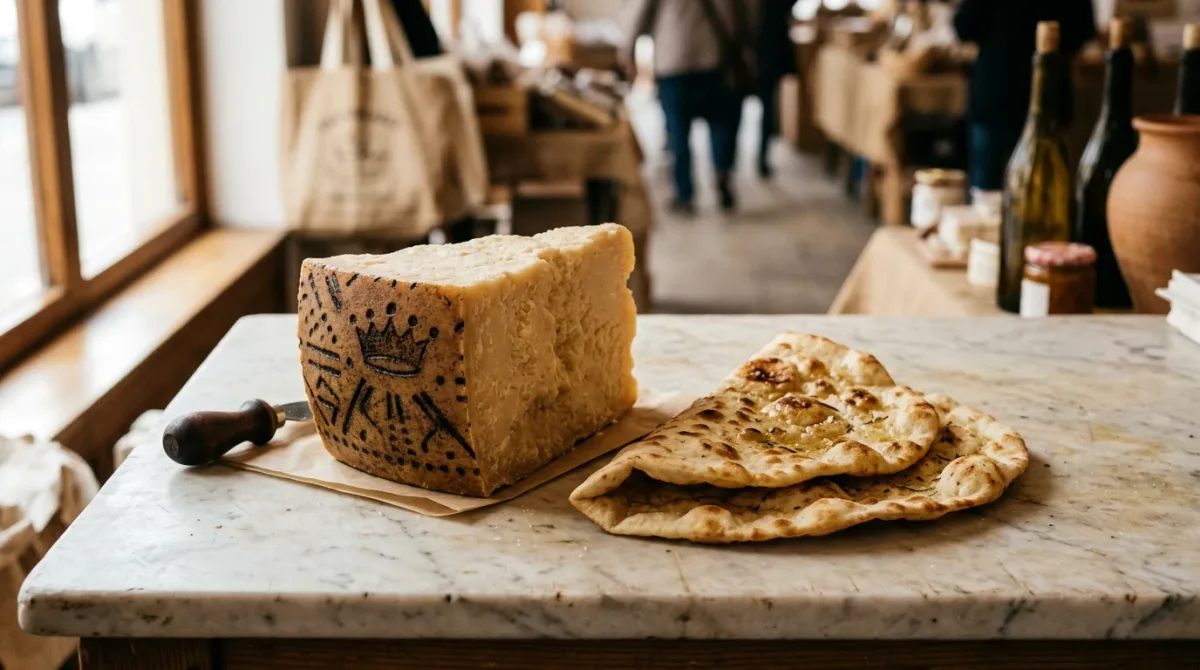
Inside that perimeter the rules run further than location. The cheese is made from raw, partially skimmed cows' milk with no additives permitted, coagulated with calf rennet, and fermented with a continuous whey starter that is the only bacterial culture allowed — the specification expressly bars added lactic acid bacteria cultures and nutritional supplements intended to encourage lactic flora. The herds are governed too: at least half the dry matter of the forage must come from hay, and at least three quarters of forage dry matter must be grown within the production area, with silage prohibited. Maturation then runs a minimum of twelve months from moulding, and only after inspection may a wheel receive the oval mark reading Parmigiano Reggiano Consorzio Tutela with the year of production, alongside the stencilled origin markings — the dairy's registration number, the month and year, and the letters DOP — impressed around the rind.
A traveler standing at a Modena counter can therefore read a wheel the way an archivist reads a ledger. The rind carries its own paperwork.
If a pizza is protected, why can it be made anywhere?
Pizza Napoletana is the instructive counter-case, and the source of most confusion about what protection means. It holds a TSG, not a PDO, which protects the manner of making rather than the ground it is made on — and the Associazione Verace Pizza Napoletana, whose rules were published in February 2008 ahead of a six-month opposition period before becoming European law, states plainly on its own news pages that anybody may still produce Neapolitan pizza without applying for the STG label. Certification there is voluntary, a registered quality mark signalling compliance with the specification, not a fence around the dish.
The specification itself is exacting. The association's method of production calls for a wood-fired oven with a dome temperature of 485°C and a cooking surface between 380 and 430°C, a bake of sixty to ninety seconds, and a dough built on 1,600 to 1,800 grams of type 00 or 0 flour per litre of water with 40 to 60 grams of salt and a small quantity of yeast — never fat, never sugar. The finished pizza may not exceed 35 centimetres across, its raised cornicione standing one to two centimetres while the centre holds at roughly a quarter of a centimetre. Two varieties are covered: marinara, dressed with tomato, oil, oregano and garlic, and margherita, with tomato, oil, mozzarella or fior di latte, grated cheese and basil. Gas ovens are permitted only where the impossibility of installing a wood-fired oven is documented.
So a pizzeria in another country may hold the certification, and a pizzeria in Naples may decline it. The mark follows the method.
What the marks do not tell a traveler
None of the three schemes assesses whether a particular kitchen is cooking well on a particular evening. They verify that a named product conforms to a filed specification, which is a different and narrower claim — a wheel of cheese may satisfy every clause of its disciplinare and still be sold badly cut and badly kept, and a superb regional dish may carry no mark at all simply because no producer group ever filed for one. Registration is an act of paperwork and collective will, not a census of what tastes good.
The scale explains why the paperwork matters commercially. The Commission put annual sales under the geographical indication schemes at more than €75 billion, amounting to 15.5 percent of EU agri-food exports, and an updated regulation that entered into force on 13 May 2024 created a single registration procedure intended to make protection faster and simpler for producers to obtain. For a traveler, that machinery surfaces as a small symbol on a label. Behind it sits a filed document anyone can read.
How the marks read across languages
The abbreviations shift with the language, which is the practical stumbling block at a counter abroad. PDO appears as DOP in Italian, Spanish and Portuguese contexts and as AOP in French; PGI becomes IGP in Italian, French and Portuguese; TSG becomes STG in Italian. The EU symbols themselves are constant regardless of the language on the rest of the label, so the logo is the more reliable object to look for than the letters beside it.
What follows from spotting one is modest and worth stating precisely: a PDO means the whole of the making happened in the named region under a published specification, a PGI means at least one stage did, and a TSG means a traditional method was followed wherever the kitchen stands. Those are the three answers on offer. The rest of the judgement stays with the person holding the fork.
For a related guides perspective, read The Truth in the Bottle: A Traveler's Guide to Buying Real Extra Virgin Olive Oil Abroad.
For more context, read Naples: The City Where Pizza Has a Rulebook.
For more context, read How SNAP food benefits work, and who qualifies as of 2026.
For more context, read The letter grade in every NYC restaurant window, explained.