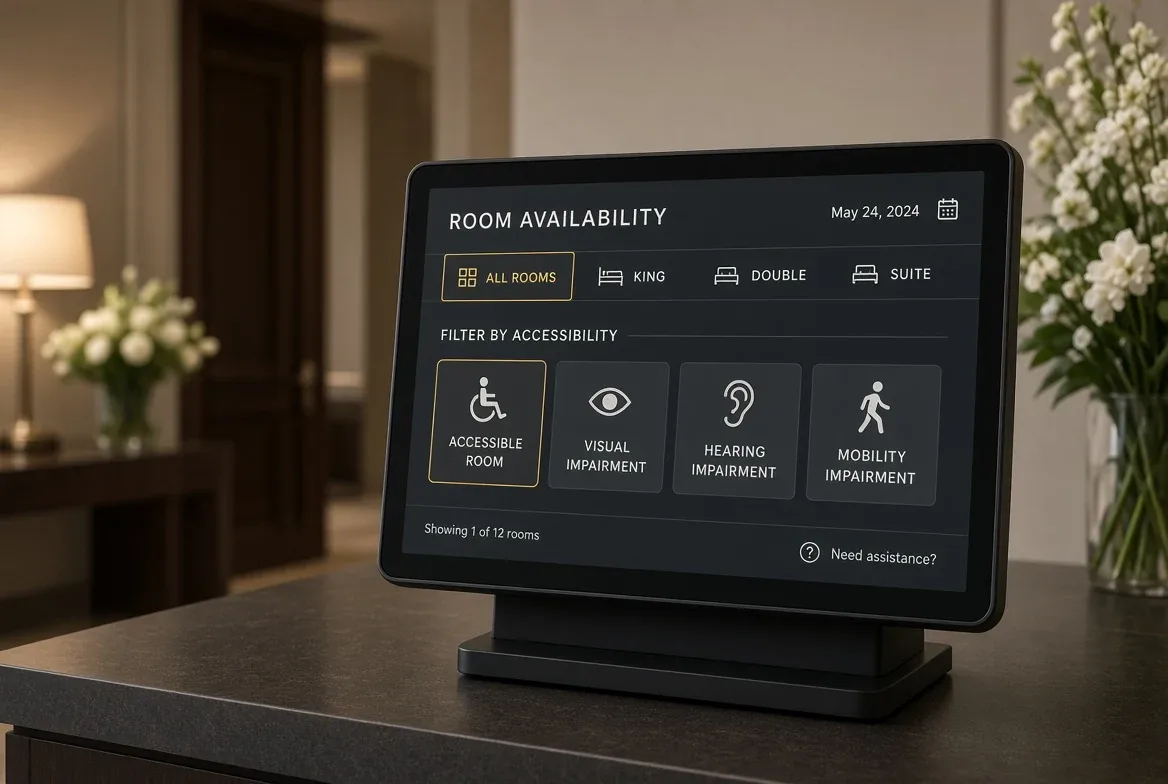
Title III of the Americans with Disabilities Act does more than set room dimensions and door widths. A federal regulation, 28 CFR 36.302(e), spells out exactly how a hotel must handle the reservation itself — rules that reach directly into booking engines and front-desk procedure, not just blueprints.
For operators, the obligation starts before a guest with a disability ever reaches the property. It starts the moment a reservation request comes in, whatever channel it arrives through.
What does federal law require when a guest books an accessible room?
Under the regulation, a hotel must let guests reserve accessible rooms "during the same hours and in the same manner" as any other guest, describe a room's accessible features in enough detail for a guest to judge independently whether it fits their needs, and hold that inventory back once standard rooms sell out.
- Accept reservations for accessible rooms "during the same hours and in the same manner" as for any other room.
- Describe a room's accessible features "in enough detail to reasonably permit individuals with disabilities to assess independently whether a given hotel or guest room meets his or her accessibility needs."
- Hold accessible rooms out of general inventory until every standard room has sold.
- Block a specific accessible room from other reservation systems once a guest requests it by type.
- Guarantee that the exact room reserved is the room the guest receives at check-in.
For a revenue manager, the third rule is the one with teeth. An accessible king room can't be released to general sale at 85% occupancy just because a full house is worth more that night. It stays held for a guest who needs it, until the property is otherwise sold out.
The rule doesn't carve out an exception for third-party channels. A reservation made through an online travel agency or a call center is still a hotel reservation, and the same hold, description and guarantee obligations attach to it — a point that matters as more accessible-room bookings arrive through distribution partners the property doesn't staff directly.
| Guest group | What the rule covers | Where it attaches |
|---|---|---|
| Guests needing mobility features | Reservation hold, room description, room guarantee | Booking engine, call center, front desk |
| Deaf and hard-of-hearing guests | TTY access, relay calls, captioning, visual alarms and notifications | Front desk, guest-room equipment, phone systems |
| Blind and low-vision guests | Alternate-format materials, Braille/raised-character signage, verbal room orientation | Reservations desk, signage, check-in procedure |
What must a hotel do to communicate with deaf and hard-of-hearing guests?
Under the Department of Justice's guidance on communicating with deaf and hard-of-hearing guests, hotels must be able to provide a TTY device on request for use in a guest room, keep a TTY at the front desk, and supply closed-caption decoders for in-room televisions on request.
Staff also need to be ready to take relay calls placed through 7-1-1. The guidance notes those calls "may take a little longer than voice calls," and front-desk teams should expect the delay rather than treat it as a dropped call. For anything beyond a short exchange, the guidance points hotels toward a sign language interpreter, an oral interpreter, or real-time computer-assisted captioning.
A share of guest rooms also has to carry built-in features: visual alarms tied into the building's emergency alarm system, visual notification devices that flash when a phone rings or someone knocks, and electrical outlets positioned to power a text telephone. Newly built or altered properties must meet these requirements under the 2010 ADA Standards; existing buildings are expected to remove the same barriers where doing so isn't unduly difficult or costly.
What does the ADA require for guests who are blind or have low vision?
A separate Justice Department guide covers guests who are blind or have low vision, and it starts at the reservation desk rather than in the room. Staff are expected to tell a guest what alternate-format materials — Braille, large print, audio recordings — a property can supply, without assuming from a guest's response how much vision they have.
Room and space signage in newly built or altered hotels must carry raised characters and Braille under the 2010 Standards, with contrast and a non-glare finish specified so a sign is legible to guests with low vision as well as guests reading by touch. The guide also recommends a specific kind of room orientation at check-in: walking a guest through where the bed, desk, thermostat and closet sit, and giving exit directions in plain, countable terms — telling a guest the emergency stairway is the fifth door on the right, rather than pointing.
Printed materials — room-service menus, thermostat instructions, checkout policies — should be available in large print or Braille, or recorded. The guide suggests large-print documents run in 18- or 20-point type in a sans-serif face such as Arial. Service animals, including guide dogs, must be allowed anywhere a hotel generally admits guests, regardless of a property's pet policy.
What does this mean for operators?
None of this is new law. Title III has applied to hotels for more than three decades, and the specific reservation rule has been in force since the 2010 ADA Standards took effect. What varies property to property is how well a booking engine, a property management system, and a front desk actually execute it.
A central reservations system that can't flag and hold a specific accessible room type — or that lets a call center release one to a walk-in — creates exposure regardless of how the building itself was constructed. The rule sits squarely in reservations technology and revenue management, not only facilities, which is one reason compliance reviews increasingly pull in IT and distribution teams alongside ADA coordinators.
The same is true of the communication and signage requirements. A TTY sitting unplugged in a storage closet, or a front-desk team unfamiliar with 7-1-1 relay etiquette, is a training and procedure gap rather than a construction one. So is a reservations agent who can't tell a guest what alternate-format materials the property keeps on hand. None of those failures show up in a building inspection; they show up the first time a guest actually calls to book.
That distinction is why the obligation doesn't fade as a property ages. A hotel built decades before the 2010 Standards took effect can still be out of step with the reservation, communication and signage rules today, independent of whatever renovation schedule its rooms are on — because those rules travel with staff and systems, not with the building shell.
For a related service perspective, read Service charges are not tips: what three federal rulebooks require of hotels.
For more context, read What Parents Should Know About Teen Work-Hour Rules.
For more context, read Lisbon: Where to Stay, Eat, and Shop in Alfama.
For more context, read How the VAT refund actually works when you shop in Europe.