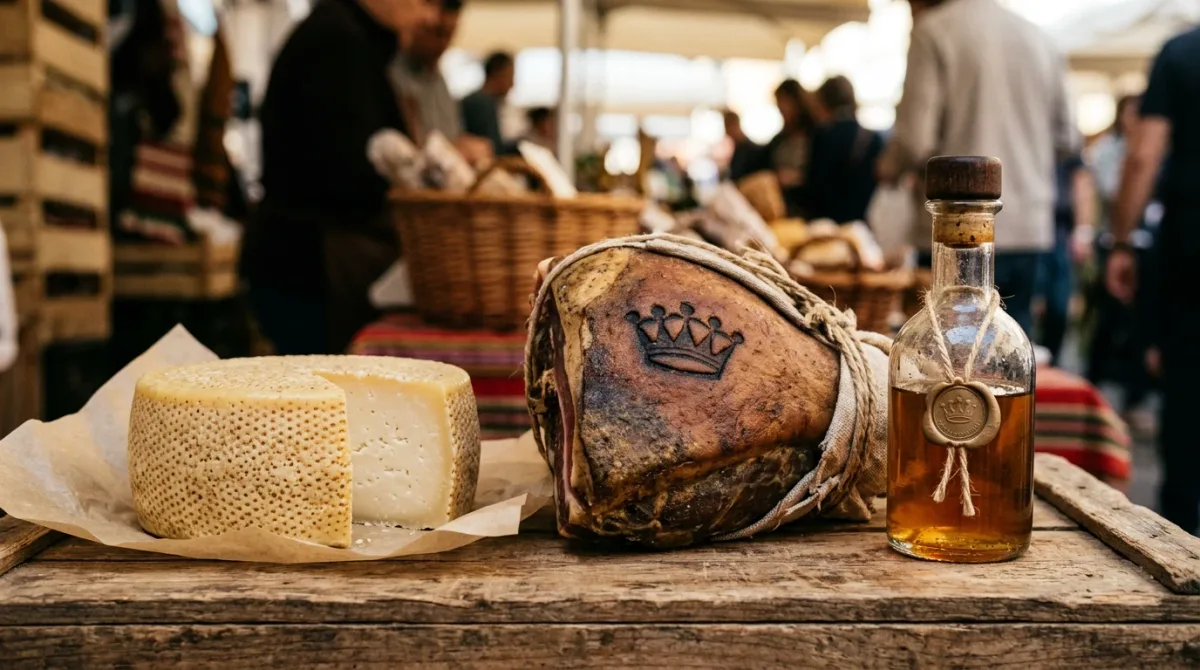
In Parma and Modena the marks burned into a cheese rind, a ham and a vinegar seal are not ornament but legal shorthand. A wheel may carry the name Parmigiano Reggiano only after at least twelve months of maturation and an inspection it can fail, a threshold written into the consortium's own product specification in force from April 2025.
That is the useful thing to understand before walking into a salumeria in Emilia-Romagna: the seals a traveler is being shown are not marketing badges but the visible end of a written rule, and each rule specifies something different. One governs where a cow may graze, another draws a boundary five kilometres south of a Roman road, a third counts in decades rather than months. Knowing which is which turns a counter into a document.
What does a DOP seal actually promise?
The European Union operates several origin schemes and they are not interchangeable. Under the bloc's official quality labels guidance, a Protected Designation of Origin — DOP in Italian, PDO in English — requires that "every step of the production, processing, and preparation must take place within the specific geographical region", while a Protected Geographical Indication asks only that "at least one stage of the production, processing, or preparation" happens there. The same guidance describes PDO products as having "the strongest links to their place of origin".
The practical consequence is worth carrying to the market. A PGI label can sit on something assembled elsewhere from ingredients that travelled; a PDO label cannot. Neither seal is a verdict on quality, and neither is a substitute for a shopper's own judgement about what is worth buying. It is a claim about geography and method, held to a text.
Why must a wheel be branded before it can carry its name?
The Parmigiano Reggiano product specification begins by drawing a map. Article 2 confines production to the provinces of Modena, Parma and Reggio nell'Emilia, together with "the part of the province of Bologna to the left of the River Reno" and "the part of the province of Mantua to the right of the River Po" — rivers doing the work that a customs line would do elsewhere.
Inside that boundary the text becomes procedural. The feeding rules require that at least half of forage dry matter come from hay and that at least three-quarters of forage dry matter be grown within the production area itself, and they bar feeds containing additives from the antibiotics group. Milk from the evening and morning milkings is delivered raw to the dairy "within two hours from the completion of each milking", and in the cheesemaking standard the instruction on additives is a single clause: none may be used. Maturation, the specification states, "shall continue for at least 12 months, starting from the cheese moulding".
Only then does the wheel acquire the marks a traveler sees. The origin markings applied at the dairy carry the words Parmigiano-Reggiano in pin-dot lettering along with the dairy's registration number, the year and month of production and the acronym DOP; after inspection, wheels that pass are given an oval mark reading Parmigiano Reggiano Consorzio Tutela with the year of production. A further designation is available only from the twenty-fourth month of maturation and depends on sensory analysis scoring above the average for the cheese. The pin dots are the birth certificate. The oval is the verdict.
Why is Parma's ham cured inside a line drawn from a Roman road?
Prosciutto di Parma separates two geographies that shoppers routinely collapse into one. Its published specification allows the raw material to come from pigs born and raised across eleven regions of central and northern Italy — Piemonte, Lombardia, Emilia-Romagna, Veneto, Friuli-Venezia Giulia, Molise, Umbria, Toscana, Marche, Abruzzo and Lazio — with animals at least nine months old and carcasses weighing between 110.1 and 180.0 kilograms.
The curing, by contrast, is confined to a narrow band. The specification places the production area in the province of Parma, "at least 5 km south of the road known as Via Emilia, extending south until it reaches a maximum altitude of 900 metres", with the Enza and Stirone rivers forming its eastern and western boundaries, and it requires that curing facilities, slicing and packaging plants and all processing phases of the raw material sit inside that zone. The permitted ingredient list is two items long: pig haunch and salt, with only sea salt allowed and additives recorded as absent. The consortium's own account of the method describes the object of the exercise as curing a leg of pork with pure sea salt so as to keep the meat sweet-tasting and supple, and states that salt is the only preservative used, with no chemical elements permitted.
The five-point ducal crown with the word PARMA inside it, fire-branded on the rind, comes last. It is applied after fourteen months from the beginning of production and after specific checks by the control body's inspectors, and the specification is blunt about what its absence means: without the ducal crown the product may not be labelled with the designation, nor appear under that name on packaging, in sales documents or in trade. Some hams are cured as long as three years. The crown is not a decoration; it is permission to use a word.
What do twelve years in a Modena loft buy?
Aceto Balsamico Tradizionale di Modena is the outlier in this trio, because its central rule is measured in years. The consortium's product specifications prohibit the use of preserved must and of must containing any additives or additional substances, leaving cooked grape must and, optionally, a seeding of mother-vinegar bacteria. Maturation, the text states, must run "in any case no less than 12 years", and the wording Extravecchio is reserved for product aged a minimum of twenty-five.
Verification and packaging are written into the same document. Batches the producer believes have reached the necessary characteristics undergo analytical and organoleptic evaluation before they may be sold, and the approved vinegar is bottled in a prescribed vessel — spherical with a rectangular base, in heavy clear glass, in volumes of 10, 20 or 40 centilitres — closed with a non-reusable serial-numbered seal that must be broken to open. A traveler comparing two bottles in Modena is therefore comparing sealed, numbered, evaluated objects with a minimum age of twelve years against a category that shares part of a name and almost none of the rules. The bottle shape is itself part of the specification.
Where can a traveler watch the rules being applied?
Dairy visits are the most accessible of the three, and they are bookable through the consortium rather than only through intermediaries. As checked on 20 August 2026, the consortium's own guided-tour directory listed sixteen dairy visits, filterable by province, language and date, with durations running from about 45 minutes to three hours and prices between roughly €15 and €50; most listings combine access to the production area with a tasting. Listings are cited here on stated criteria — that they appear on the consortium's own booking directory, are bookable by the public, and show duration and price — and nothing on that directory is included in exchange for access or payment. Individual dairies set their own calendars, so dates and prices should be reconfirmed on the listing before travel.
What to check at the counter
The checks follow from the texts rather than from folklore. On a cut piece of Parmigiano Reggiano, look for the pin-dot lettering and the dairy number carried on the rind, and read the oval mark as the record of an inspection passed. On a whole or bone-in Parma ham, the five-point crown is the element the specification treats as decisive. On traditional Modena vinegar, the prescribed bottle and the numbered seal do the identifying work before any price is discussed.
None of this settles what a traveler will enjoy, and none of it ranks one region's larder against another's. It settles a narrower question: whether the name on the label is one the producer is entitled to use. In Emilia-Romagna, that answer is stamped in.
For a related hotels perspective, read Hotel Points, Off the Property: How Dining Rewards Programs Actually Pay Off.
For more context, read Mexico City: Where the Mercado Still Sets the Table.