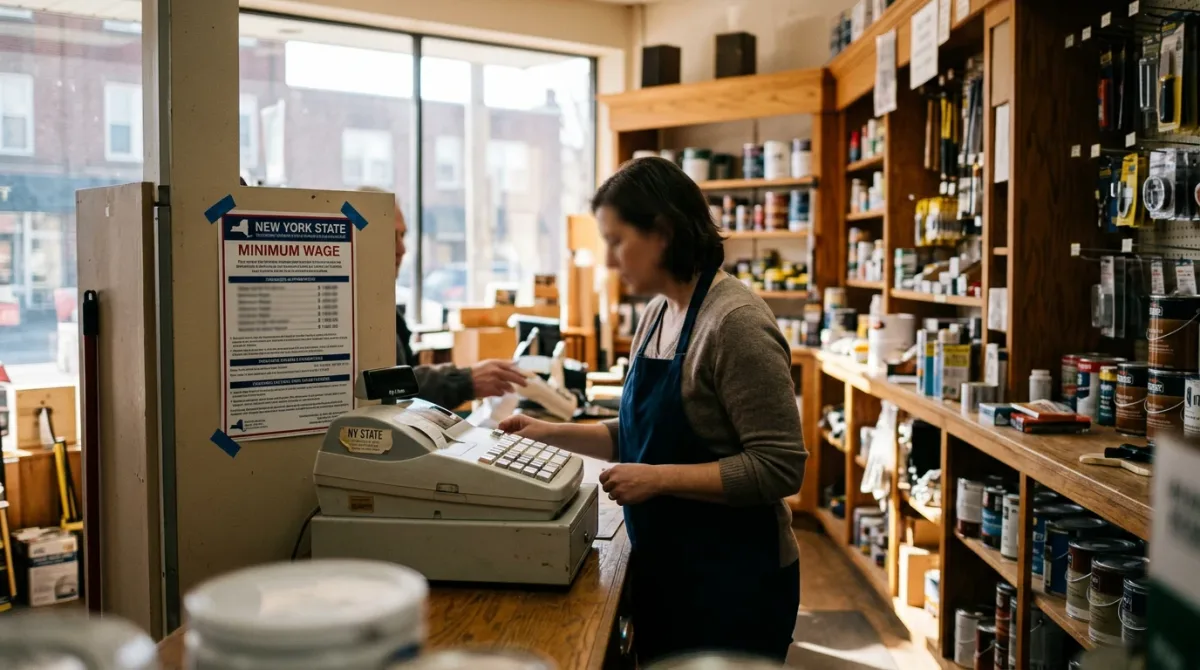
Rockland County's minimum wage is $16 an hour as of January 1, 2026, the rate the state has set for the "remainder of New York State" tier, according to the New York State Department of Labor. Workers in New York City, Long Island and Westchester County are owed $17 an hour under a separate, higher tier. Starting in 2027, the state plans to stop setting fixed annual increases and instead tie future raises to inflation.
What is the minimum wage in Rockland County right now?
As of January 1, 2026, the minimum wage across Rockland County is $16 an hour, the Department of Labor says. That figure covers every town and village in the county — Clarkstown, Ramapo, Orangetown, Haverstraw, Stony Point and the villages within them — because none of them fall inside the higher-paying downstate tier the state reserves for New York City, Long Island and Westchester County.
The rate applies to most hourly workers covered by state wage law, whether they work at a diner in Nyack, a landscaping company in Ramapo or a retail shop in Suffern. Employers who also do business across the county line in Westchester need to track both rates, since a single company can be subject to two different minimums depending on where an employee actually works. A worker who splits shifts between a Rockland location and a Westchester location, for instance, is owed the higher rate for the hours worked on the Westchester side.
The $16 figure is a floor, not a ceiling — nothing in state law stops a Rockland employer from paying more, and the Department of Labor's rate applies regardless of a business's size or how many people it employs.
Why does Rockland pay less than New York City?
New York's minimum wage law divides the state into two geographic tiers. New York City, Long Island and Westchester County — the highest cost-of-living areas — get a higher wage floor, currently $17 an hour. The rest of the state, including Rockland, follows a separate and lower schedule that reached $16 an hour with the January 2026 increase, per the Department of Labor's published rate table.
Rockland sits just north of Westchester and within commuting distance of New York City, which has made the two-tier split a point of friction for local business groups in the past — workers can cross a county line for a dollar-an-hour raise without changing jobs. The state has not announced any plan to move Rockland into the higher tier, and the Department of Labor's guidance treats the two schedules as a settled, ongoing feature of state wage law rather than a temporary gap.
How does the tip credit work for restaurant and salon workers?
Hospitality employers in Rockland — restaurants, bars and similar businesses — are allowed to pay tipped workers a lower direct cash wage and count part of their tips toward the $16 minimum, a practice the state calls a tip credit. Tipped service employees can be paid $13.30 an hour in cash, with a $2.70 tip credit; tipped food service workers can be paid $10.70 in cash, with a $5.30 tip credit, according to Department of Labor wage requirements.
The department is explicit that this credit is limited to hospitality employers — retailers, offices and most other Rockland businesses cannot apply it, even if their workers happen to receive tips. A hair salon or a car wash, for example, cannot shave a worker's hourly wage down simply because customers sometimes leave cash. Employers that do qualify are required to post industry-specific minimum wage notices, including the Miscellaneous Industries poster and the Building Service Industry poster, in a place employees can see them, and to make up the difference out of pocket on any day tips don't cover the credit.
What changes about the minimum wage in 2027?
Beginning in 2027, New York is scheduled to stop raising the minimum wage on a fixed year-by-year schedule and instead adjust it annually based on a three-year average of the Consumer Price Index for the Northeast, according to the Department of Labor. In practice, that means the size of future increases will track inflation rather than a number lawmakers set years in advance — a slower year for prices could mean a smaller raise, and a sharper run of inflation could push the rate up faster than the fixed-schedule years did.
The department's guidance also notes that the state's planned annual increases "may be affected by certain economic and budget conditions," leaving room for the formula to be adjusted. As of this writing, the state had not published an exact dollar figure for the 2027 rate in Rockland, which makes it hard for local business owners to budget next year's payroll with full certainty — a gap Rockland Review News will follow as the state's Division of the Budget finalizes the number.
What happens if a Rockland employer doesn't pay the minimum wage?
Workers who believe they were paid less than the legal minimum can file a complaint directly with the New York State Department of Labor rather than going to court first. The department says it works to recover back wages for underpaid workers "often ... without resorting to court action," and it directs wage complaints and compliance questions to its hotline at 888-525-2267.
For business owners trying to keep up with state labor rules, Rockland County's own Office of Economic Development, Tourism and Film is a local point of contact — the office has been soliciting topics for a newsletter and a podcast, "Rockland Roundtable," aimed at county businesses, according to the county government's website. It's a modest resource next to a state hotline, but it's the closest thing Rockland has to a local translator for Albany's wage rules.
For a related government perspective, read How to request public records from Rockland's town and county governments.
For more context, read What Parents Should Know About Teen Work-Hour Rules.
For more context, read Prime Is 6.75%: How That Number Reaches Your Loan.
For more context, read Retail Sales Fall 0.6% in July as Inflation Holds at 3.4%.